
Calamos Investments is set to launch the world’s first autocallable growth ETF, marking a new phase in the evolution of structured product strategies within the ETF wrapper.
The Calamos Autocallable Growth ETF (CAGE) is scheduled to list on the NYSE on April 16, 2025, extending the firm’s first-mover advantage following the launch of autocallable income ETFs earlier this year.
Key Highlights
• Product Innovation: CAGE is the first ETF to deliver autocallable growth strategies, traditionally available via bank-issued structured notes, in a liquid and accessible format.
• Structure: The ETF provides synthetic exposure via swap (J.P. Morgan) to a laddered portfolio of 5-year autocallable growth notes.
• Underlying Index: Tracks the MerQube US Large-Cap Vol Advantage Autocallable Growth Index (MQAUTOCG).
• Performance Profile: The index has delivered ~23.75% annualized returns (10Y, illustrative), albeit with higher volatility and deeper drawdowns vs. S&P 500.
• Mechanics: Coupons are not distributed but reinvested, enabling tax-efficient compounding via a “snowball” feature.
• Risk Profile: Includes a 50% downside barrier, with principal at risk if breached at maturity.
From Income to Growth: Expanding the Autocallable ETF Universe
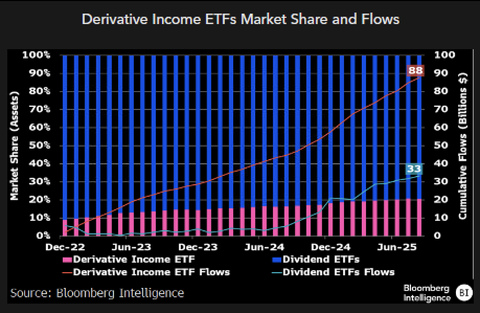
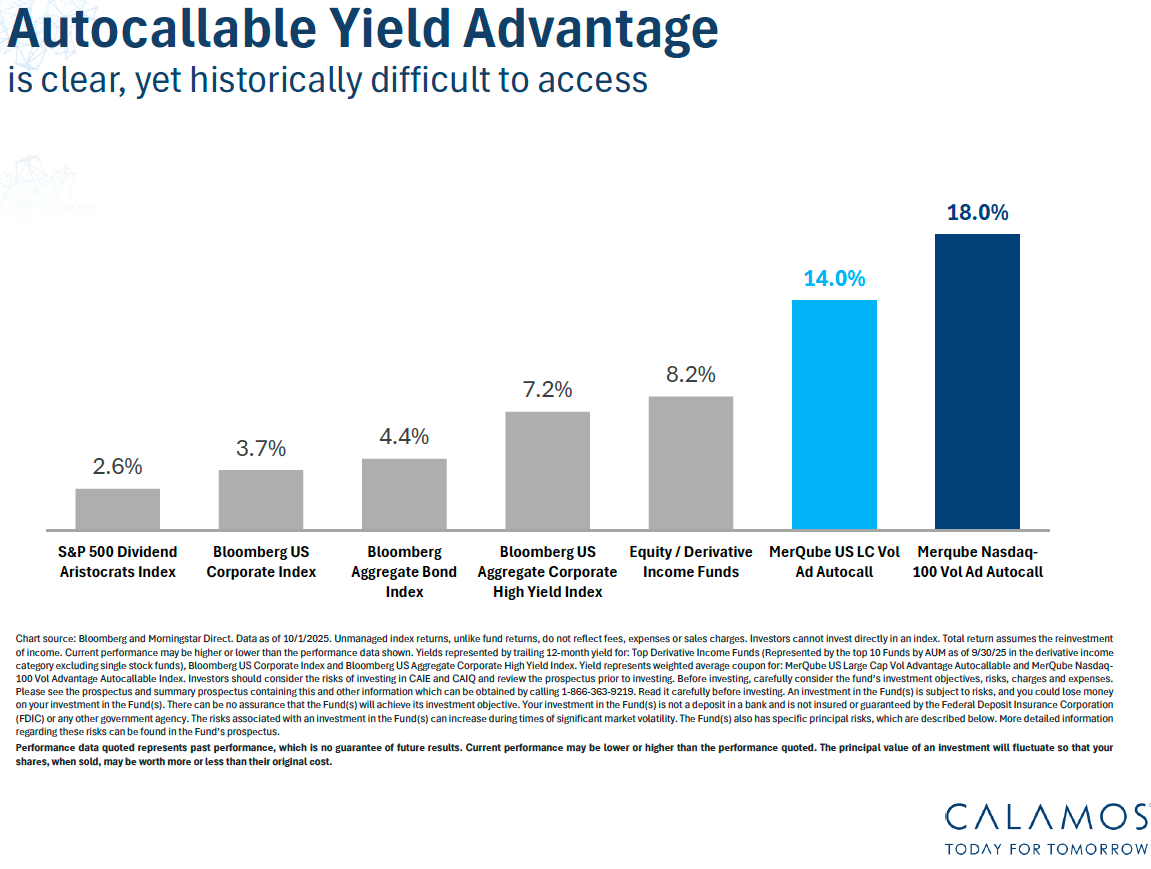
CAGE builds on Calamos’ earlier launches of autocallable income ETFs (CAIE, CAIQ), which have attracted steady inflows and demonstrated demand for derivative-based yield strategies in ETF format.
While income Autocallables focus on high coupon distribution, the growth variant shifts toward capital accumulation, reinvesting coupons and leveraging long-dated option-selling dynamics.
This positions CAGE within the broader trend of “Structured 2.0” ETFs, where traditional structured product payoffs are repackaged into scalable, transparent vehicles.
Market Context: Growth Autocallables Gaining Share
Growth-oriented autocallable structures are an increasingly significant segment of the structured products market:
• Represented ~32% of U.S. callable issuance in 2025, up from 19% in 2021
• Total structured product issuance approached USD 1 trillion globally in 2025
The ETF wrapper now allows broader investor access to these strategies, historically limited to high-net-worth channels.
Investment Positioning
CAGE is designed for:
• Growth-oriented investors seeking enhanced equity returns
• Long-term holders (5+ years) willing to accept higher volatility
• Portfolio construction use cases such as:
o Equity alternative / enhancer
o High-growth satellite allocation
o Tax-efficient compounding exposure
However, the strategy introduces complex payoff dynamics and elevated volatility, requiring careful positioning within portfolios.
Structural Considerations
The ETF employs a weekly laddered structure (~52 notes) to:
• Reduce timing and concentration risk
• Smooth return profiles across vintages
Key features include:
• Annual observation dates (vs. monthly in income products)
• Coupon “memory” and reinvestment
• Exposure to a volatility-targeted large-cap equity index
Outlook
The launch of CAGE represents a natural extension of autocallable strategies into the growth segment, reinforcing the trend of:
• Convergence between structured products and ETFs
• Increasing demand for engineered equity exposure
• Expansion of derivative-based strategies in retail-accessible formats
If adoption mirrors the trajectory of autocallable income ETFs, growth Autocallables could become a distinct and scalable category within the ETF ecosystem.
A full methodology and historical performance analysis of the underlying index is available in the MerQube Autocallable Growth Index factsheet [here].