
Buffer ETFs now hold more assets than buffered notes. iCapital m+ ETFs and HSBC set out to fix what advisors still disliked about them.
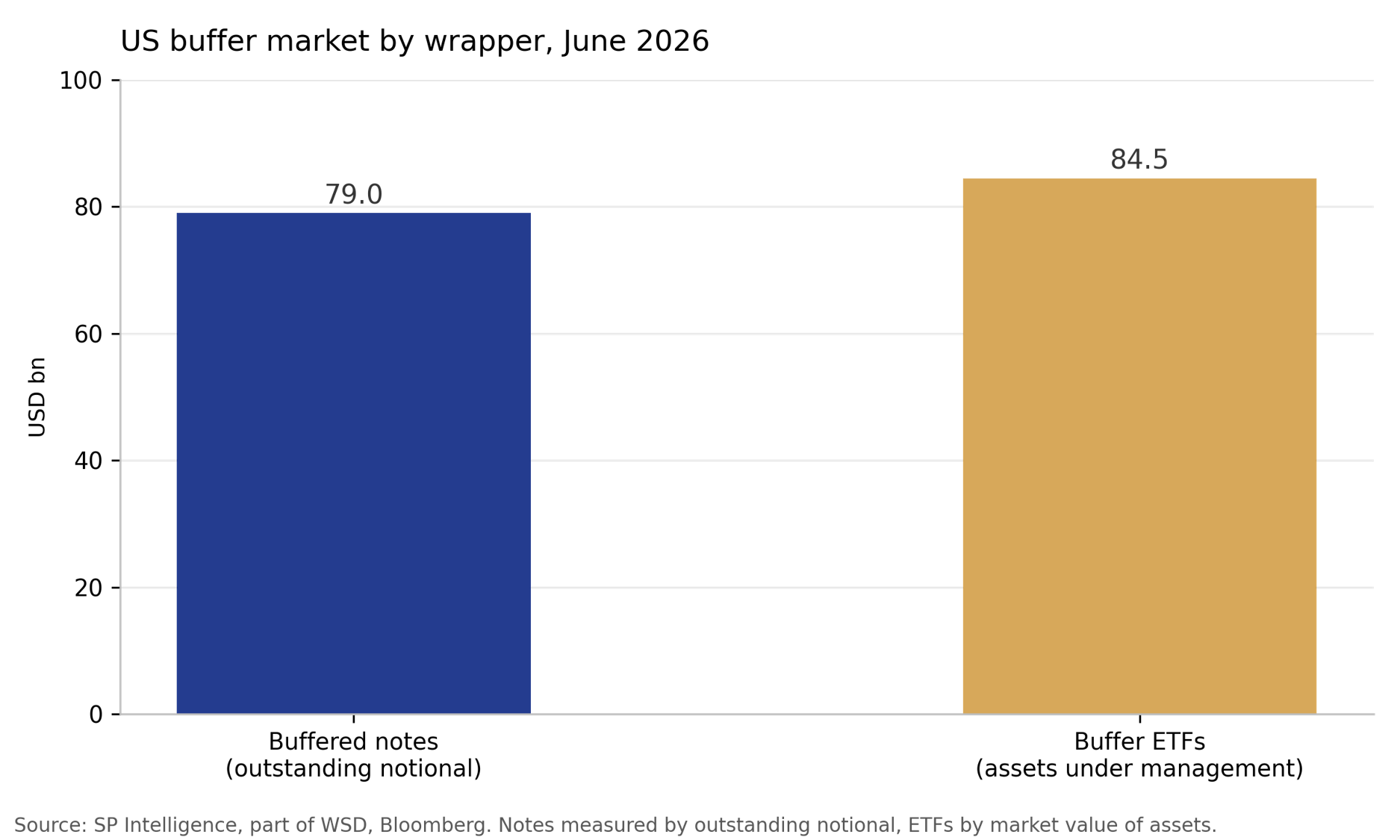
The wrapper has taken the lead in the protection trade. According to SP Intelligence and Bloomberg data, buffer ETFs held $84.5 billion at the end of June 2026, against $79.0 billion of buffered notes outstanding, having overtaken the note market for the first time in 2025. ETFs accounted for around 12% of the combined buffer market at the end of 2020 and roughly 52% by June 2026.
Into that market, iCapital launched the m+ DynaBuffer ETF (MPDB) on 12 August 2026, built in partnership with HSBC and tracking the HSBC DynaBuffer US Large Cap Index. The fund has an expense ratio of 0.70%. The award recognises a design that addresses the main weaknesses of first-generation buffer products, timing dependence and capped upside, and a structure that brings a bank-designed strategy index into an ETF built for model portfolios. That has earned the m+ DynaBuffer ETF Best Structured ETF at the SP Intelligence USA 2026 Awards for Excellence.
Enhancing the buffer
Nick Parcharidis, Managing Director, iCapital m+ funds and iCapital m+ ETFs, and a former head of Citi’s Americas structured products business, says advisors had three concerns about existing buffer products: resets too infrequent to protect in drawdowns, too little upside over the buffer tenor, and an annual reset that concentrated market timing risk.

HSBC built the index to address that trade-off. “Some advisors and investors feel that incumbent buffer notes and ETFs require investors to surrender too much upside in exchange for protection that can still be highly dependent on timing,” says Jon Neumann, Managing Director and Head of US Structured Product Sales for the Americas at HSBC, who has spent more than 20 years at the bank.

The methodology answers each concern. A ladder of overlapping structures, each starting on a different date, reduces dependence on any single entry point. The downside protection resets periodically, so it does not go stale after markets rise. And shorter-dated downside protection is combined with longer-dated upside participation, which allows for higher caps than a traditional structure where both run for the same term. “It is not just buffered equity,” Neumann says. “It is buffered equity redesigned around the actual problems advisors have had with incumbent solutions.”
As of 23 October 2026, the index held 156 overlapping buffered structures on the SPDR S&P 500 ETF Trust (SPY), adding a new one each week, according to iCapital. Each targets a 10% downside buffer, reset quarterly, alongside 1.5 times the upside of SPY over three years, up to a cap. Across the portfolio, the average initial cap was 58.4%.
Risk management
The fund’s prospectus sets out the main risks. The buffer only absorbs losses up to its target level; beyond that, investors bear losses in full, and in a severe sell-off the fund can fall sharply. Upside is capped, so the fund will not keep pace with SPY in strong rallies. The laddered, weekly rolling approach is designed to spread timing risk but cannot remove it: in fast-moving or prolonged weak markets, new positions may be added at unfavourable levels and several may lose value at the same time. Because the fund gains its exposure through a swap with HSBC, investors also take counterparty risk to the bank, and as a new ETF it has a limited operating history and may trade at a premium or discount to its net asset value.
Built for the wrapper
Both partners argue the ETF is the natural home for the strategy. DynaBuffer is a continuously maintained, laddered exposure, “a living, ongoing exposure, not a one-off trade”, in Neumann’s words. A note is issued on one date and held to a fixed maturity. In model portfolios, each note brings its own maturity and replacement decision, which fragments positions across client accounts.
That matches the wider market. Between the end of 2020 and June 2026, buffer ETF assets grew by roughly $80 billion, against roughly $44 billion for buffered notes outstanding, according to SP Intelligence and Bloomberg data. Both are growing, but the ETF is taking the larger share of new demand for standardised, rolling protection, while bespoke outcome-oriented strategies stay in note form.
HSBC’s role shows how banks can stay in the economics as outcome-oriented strategies move into the wrapper: it is both the index sponsor and the fund’s swap counterparty, rather than the issuer of a note. That is also a design choice. Most buffer ETFs are built from exchange-listed FLEX options, but a laddered, dynamically resetting index like DynaBuffer is delivered through a total return swap, in which HSBC pays the fund the return of the index.
Who is buying
Advisors running model and fee-based advisory portfolios are the early adopters, Parcharidis says. Most use the ETF as a hedged equity complement to a long equity allocation. Some use it in the fixed income sleeve instead, allocating part of a 60/40 portfolio to improve return and risk outcomes that bonds have struggled to deliver, particularly in sell-offs.
Two wrappers, one category
Parcharidis expects outcome-oriented strategies to keep growing in both wrappers. Advisors will continue to express market views through customised notes, he says, while structured ETFs are likely to grow as portfolio building blocks, helped by daily liquidity and ease of access.
The buffer ETF did not displace the note so much as take the standardised part of a growing category. DynaBuffer’s bet is that the standardised part can still be designed better.
Key terms
Buffer: The portion of losses, measured from the start of a structure, that the strategy is designed to absorb. Losses beyond the buffer are borne by the investor.
Cap: The maximum return a structure can deliver, however far the market rises.
Ladder: A portfolio of overlapping structures started on different dates, so that results do not depend on a single entry point.
FLEX options: Exchange-listed options with customisable terms, cleared through a central counterparty.
Total return swap: A contract in which a bank pays a fund the return of an index in exchange for a fee or financing payment.
Model portfolio: A pre-built asset allocation that an advisor applies across many client accounts.
Source: SP Intelligence, part of WSD, Bloomberg, iCapital. Market data as of 30 June 2026; fund data as of 23 October 2026. Buffered notes are measured by outstanding notional and buffer ETFs by market value of assets.