
Its Volatility Advantage indices sit behind almost a third of US QIS-linked notes. As structured strategies spread across wrappers, MerQube sees indices opening new opportunities for the banks and issuers it works with.
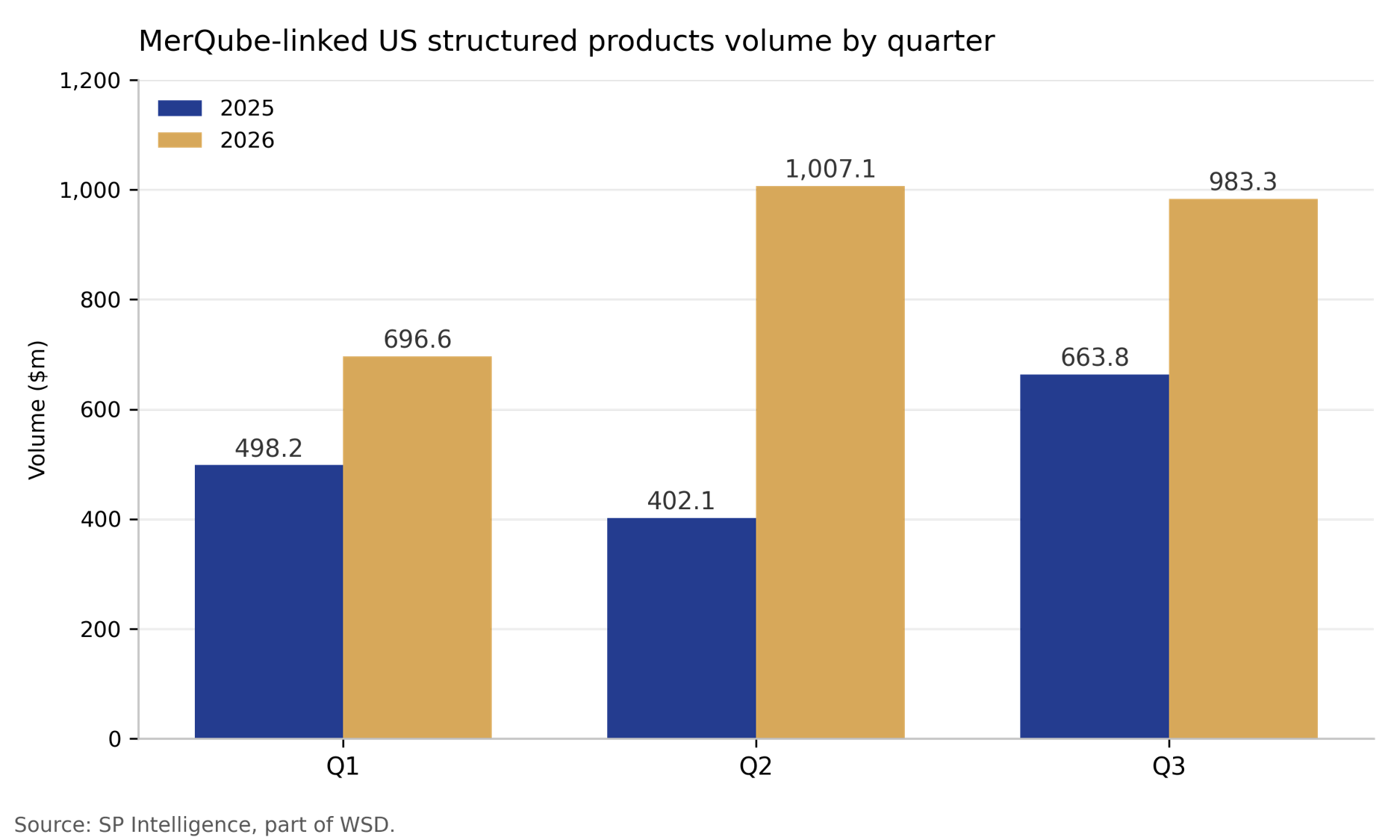
Through September, QIS-linked notes on MerQube indices totalled $2.69 billion, up 71.8% year on year and almost a third of all QIS-linked volume in the US. That makes MerQube the largest non-traditional index sponsor behind US structured notes, and four issuers now use its indices, up from two a year ago. That performance has earned MerQube Best Non-Traditional Index Provider at the SP Intelligence USA 2026 Awards for Excellence.
Engineering, not just design
Volatility targeting is not new. What MerQube changed is how it is done. Its Volatility Advantage indices use option-implied volatility to set leverage and rebalance on the same day using intraday market data, which allows them to “respond more dynamically to changing market conditions”, say Tianyin Cheng, Head of Products, and Keith Loggie, Co-Founder and Head of Research at MerQube. The family, led by the US Large-Cap and US Tech+ Vol Advantage indices, accounts for $2.53 billion, or 94.0%, of MerQube-linked volume.


MerQube credits the combination of financial engineering with its own technology. Sophisticated index design, they say, “depends on a robust calculation platform, access to rich market data and the ability to process complex strategies reliably at scale”. Close collaboration with major financial institutions has done the rest.
Fast, but governed
Speed to market is the usual pitch for next-generation index platforms. MerQube’s technology can configure certain standardised indices within minutes, although taking a new index into production still involves engineering, validation, governance review and data integration. The harder part is moving quickly without loosening controls.
MerQube has automated much of the index lifecycle, from methodology generation and review to data validation, calculation controls and ongoing monitoring. The distinction it draws is between flexibility in index design and consistency in index administration. Clients get customised strategies “without compromising the transparency, independence and governance standards expected of an institutional index provider”.
Autocallables, in notes and ETFs
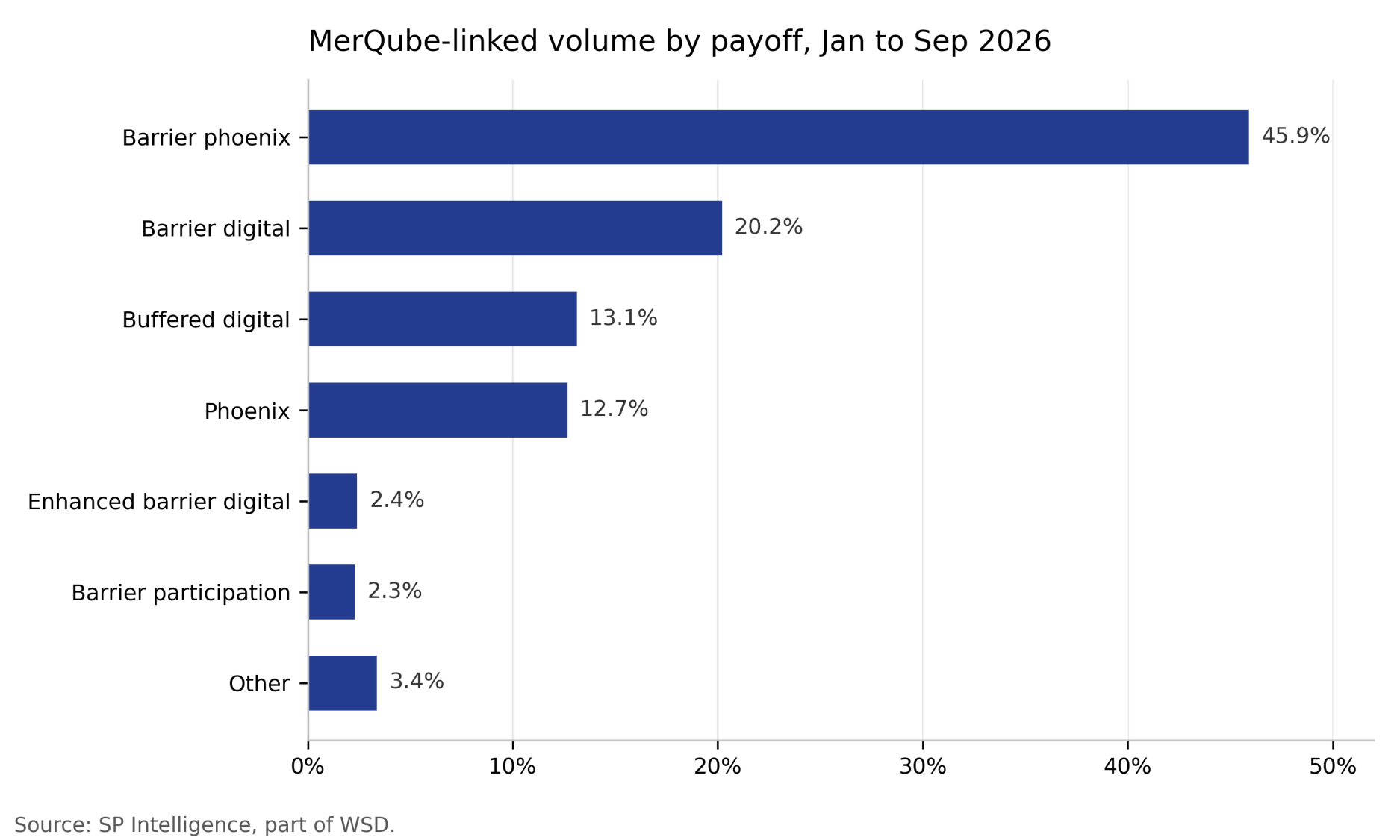
Demand is concentrated in one structure. Notes with an autocall feature account for 98.1% of MerQube-linked volume, including contingent-coupon and review notes, and barrier phoenix notes alone make up 45.9%.
That structure is also reaching new wrappers alongside bank-issued notes. MerQube points to the Calamos Autocallable Income ETF (CAIE), which references a MerQube index, as an example of how structured strategies can reach a broader investor base through ETFs. Beyond autocallables, it sees demand for volatility-managed strategies, options-based income, defined-outcome exposures and systematic strategies across asset classes.
In MerQube’s view, indices are taking on a broader role, giving the banks and issuers it works with a systematic foundation for an expanding range of structured products.
The next phase
MerQube sees two opportunities for 2027: structured strategies reaching more investors through ETFs and other accessible vehicles, and growing demand for indices built on options, intraday rebalancing and dynamic allocation. The challenge is delivering that complexity “at scale without compromising transparency, governance or operational robustness”.
The winners, they argue, will not be the providers that launch indices fastest, but those that combine investment expertise, technology and institutional-grade administration. MerQube built its position on engineering. Keeping it will depend on that engineering scaling with its bank and issuer partners, across notes and new wrappers.
Source: SP Intelligence, part of WSD. Data covers 1 January to 30 September 2026, compared with the same period of 2025.