The announcement
Calamos Investments (founded 1977, $53bn AUM) has announced significant autocallable ETF news for income investors, marking another worldwide market first from the ETF team led by Matt Kaufman.
PR Newswire: Calamos Extends Autocallable Leadership through CAYN: World's First Indexed Least-Of Autocallable Income ETF
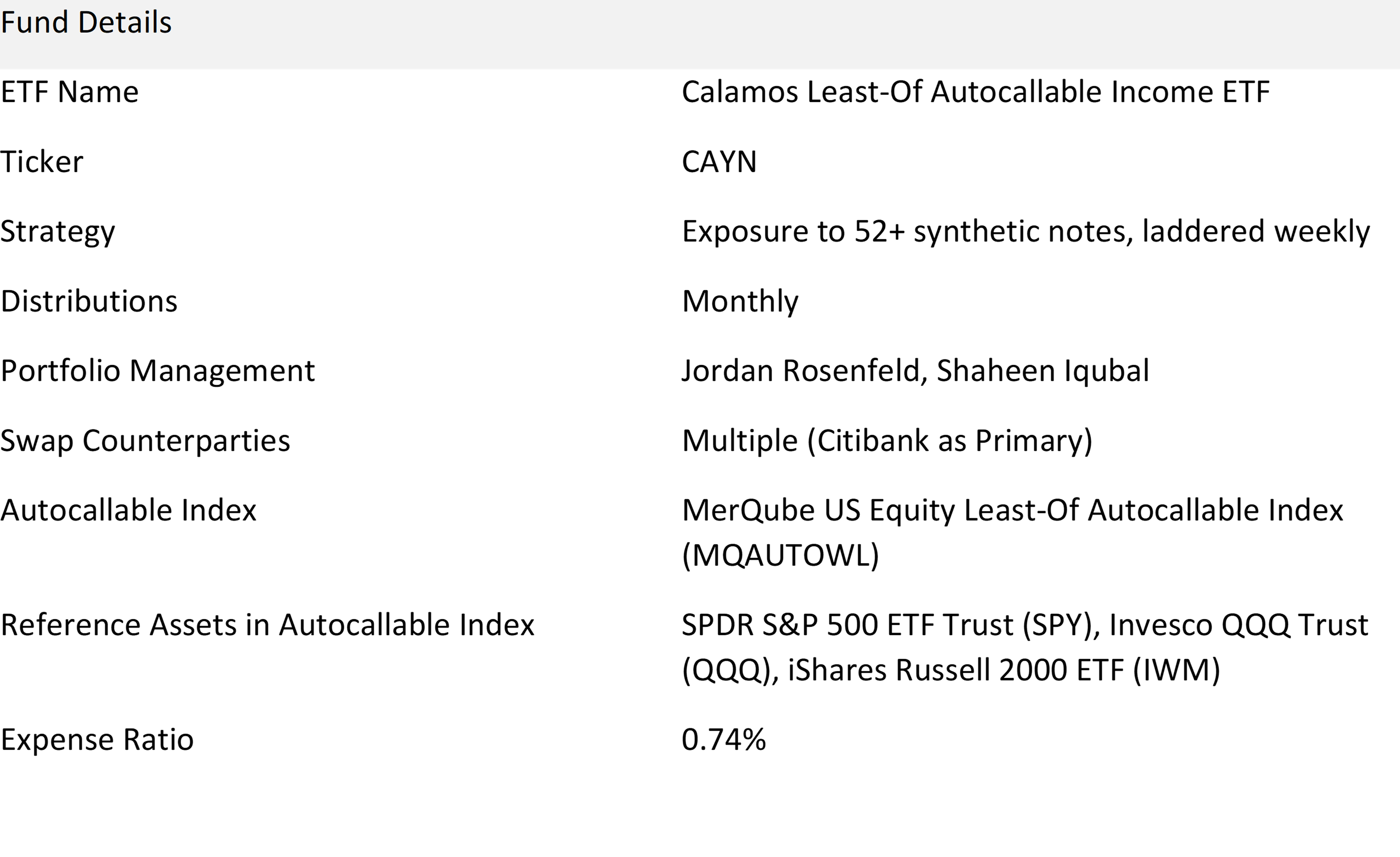
With its indexed approach, the soon to list CAYN intends to improve the risk, transparency and tax flaws of legacy notesand ETFs that use the “least-of” (aka “worst-of”) strategy and deliver better results than other worst-of autocallable ETFs, including:
- Reducing likelihood of coupon loss and principal at risk;
- Enhancing tax-efficiency and after tax-income;
- Delivering better trading (tighter spreads and NAV discounts/premiums), especially during periods of heightened volatility; and
- Using an index to illustrate historical results so investors can better understand how the strategy may behave in different market environments, such as the GFC or Covid drawdown.
For investors interested in the worst-ofstrategy, CAYN’s “systematic rules-based index could chart a new course for the sector” per Risk.net. Citi, the partner bank on CAYN, told Risk: “All the work that has been done in banks for 30 years is being transferred into the QIS index.” CAYN is “likely to appeal to ‘the vast majority of the advisers in the US’”.
Why this matters
With about 30% of autocallable structured note sales in the legacy bank channel YTD through August and 28% of 2025issuance (per SRP), the “least-of” (aka “worst-of”) strategy is the mostpopular autocallable strategy.
SPi put autocallable note sales in the U.S.at $116 billion in 2025 (52% of the total U.S. structured products market),with 2026 on track to beat that annual record (on pace for $140bn throughJuly).
Autocallable ETF demand
CAYN follows Calamos’ launch of CAIE($1.4bn AUM), the first ever autocallable income ETF, in June 2025, the Nasdaq version (CAIQ; $385mn) in November and the world’s first ever growth autocallable strategy CAGE ($175mn) this April, as well as the first ever autocallable UCITS ETF (also in April).
Investor demand for the ETFs, principally through financial advisors (mostly RIAs), has been significant and steady, with a streak of weekly inflows to CAIE, CAIQ and CAGE.
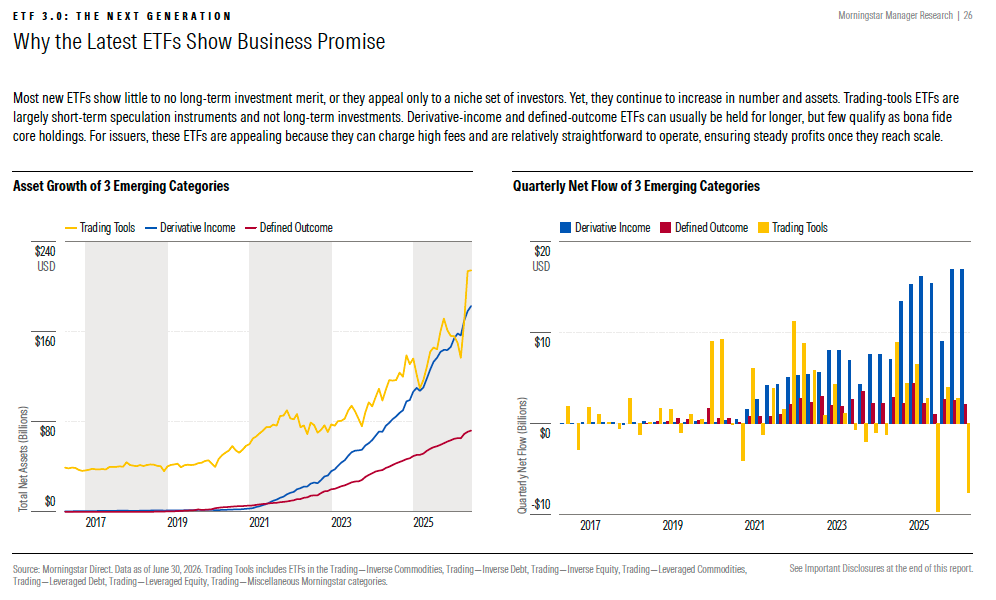
Autocallable ETFs are the fastest growing sub-category (10x AUM YTD from $591mn to ~$6bn) within the Derivative Income Morningstar category, which has seen record flows this year (over $50bn YTD through Sept.) to reach nearly $200bn AUM (per Morningstar’s State of U.S. ETFs 2026 Report).
How CAYN works
CAYN is designed to generate a high, tax-efficient income stream by referencing the worst-performing constituent of a basket of ETFs representing Large-cap stocks (SPY), Growth stocks (QQQ), and Small-caps (IWM).
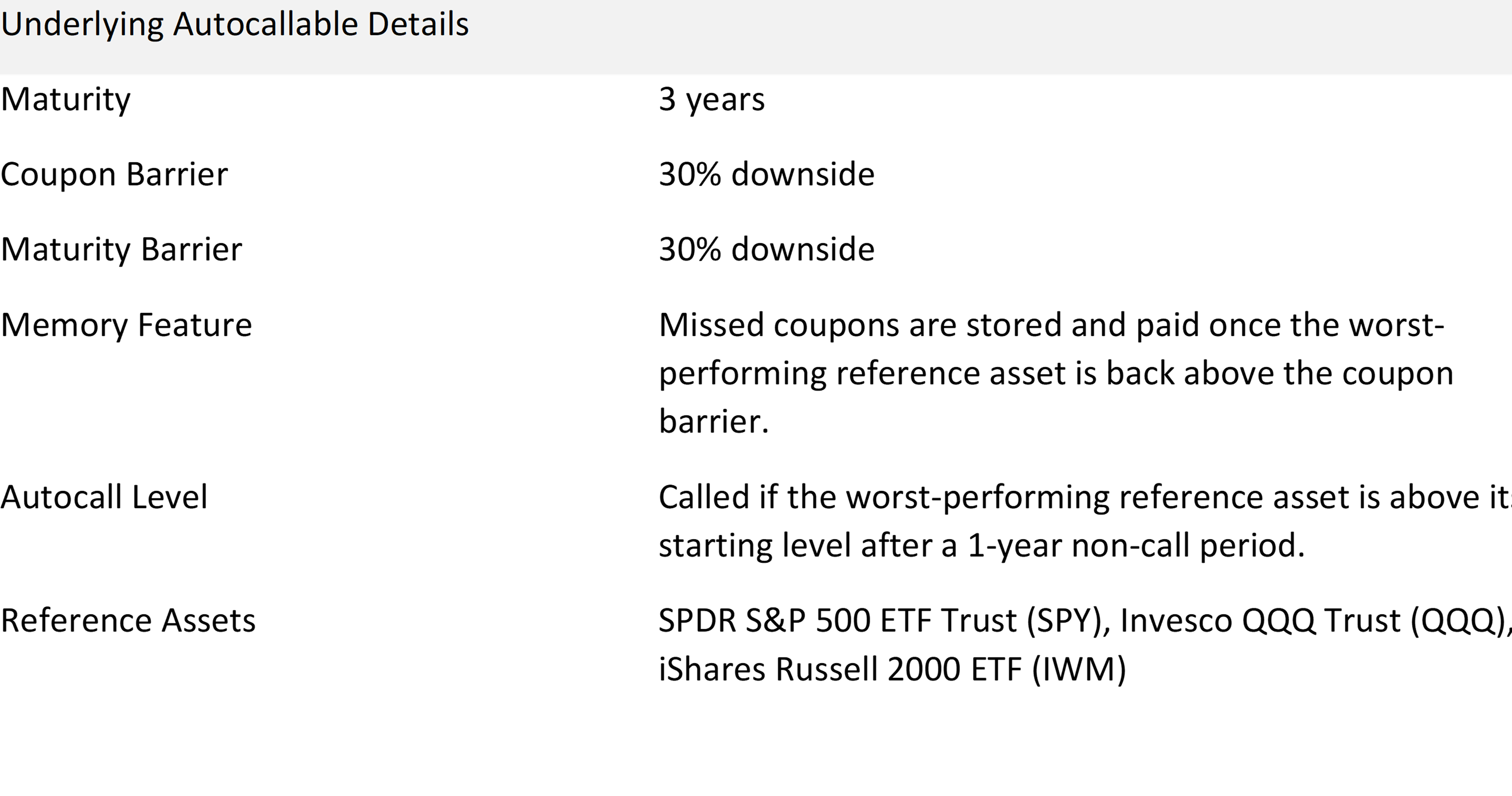
Rather than investing in a single worst-of autocallable note (“note”), the ETF provides exposure to a weekly ladderedindex of at least 52 three-year synthetic worst-of autocallable notes. When a note in the portfolio is called away, the principal will be returned into the fund and automatically reinvested into a new note with the same terms.
Seeking to deliver a transparent, rules-based and lower risk version of the popular worst-of autocallable income strategy, the notes in CAYN’s autocallable index are longer in duration, allowing each note more time to recover and thus reduce risk of principal impairment of any note.
Memory feature
CAYN’s index also features a “memory”mechanism, whereby any note’s coupons that are missed due to any constituent being below the -30% barrier will be stored and paid if and when the worst-performing constituent returns above the barrier level. Memory can improve the strategy’s income generation properties over time, especially as markets recover from drawdowns.
About Calamos
Calamos is a diversified global investment firm, headquartered in the Chicago metropolitan area, offering innovative investment strategies, including autocallables, Bitcoin, liquid alternatives, convertible, equity, fixed income, multi-asset, hedge fund, private credit, and private equity. With more than $53 billion in AUM, including more than $26 billion in liquid alternatives assets as of September 30, 2026, the firm offers strategies through ETFs, mutual funds, closed-end funds, interval funds, UCITS funds and separately managed portfolios. Clients include financial advisors, wealth management platforms, pension funds, foundations & endowments, and individuals, globally. For more information, visit us on LinkedIn, X (formerly Twitter), Instagram (@calamos_investments), or at www.calamos.com
Before investing, carefully consider the Fund's investment objectives, risks, charges and expenses. Please see the prospectus and summary prospectus containing this and other information which can be obtained by calling 1-866-363-9219. Read it carefully before investing.
An investment in the Fund is subject to risks, and you could lose money on your investment in the Fund. There can be no assurance that the Fund will achieve its investment objective. Your investment in the Fund is not a deposit in a bank and is not insured or guaranteed by the Federal Deposit Insurance Corporation (FDIC) or any other government agency. The risks associated with an investment in the Fund can increase during times of significant market volatility. The Fund also has specific principal risks, which are described below. More detailed information regarding these risks can be found in the Fund's prospectus. The principal risks of investing in the Calamos Least-of Autocallable Income Fund include: authorized participant concentration risk, autocallable structure risk, contingent income risk, early redemption risk, barrier risk, box spread risk, calculation methodology risk, cash holdings risk, correlation risk, costs of buying and selling fund shares, counterparty risk, credit risk, derivatives risk, equity securities risk, FLEX options risk, index risk, interest rate risk, investment in a subsidiary, laddered portfolio risk, liquidity risk, market maker risk, market risk, new fund risk, non-diversification risk, other investment companies risk, premium-discount risk, secondary market trading risk, swap arrangement risk, swap agreement termination risk, tax risk, trading issues risk, valuation risk.
Autocallable Structure Risk — The Fund's returns are correlated to the performance of a theoretical portfolio of Autocallables reflected by the Autocallable Index. Autocallable notes have specific structural features that may be unfamiliar to many investors.
Contingent Income Risk — Coupon payments from the Autocallables are not guaranteed and will not be made if the least performing Constituent falls below the Coupon Barrier on Observation Dates. This means the Fund may generate significantly less income than anticipated during market downturns.
Barrier Risk — If the least-performing Constituent falls below the Maturity Barrier at the maturity of an Autocallable in the Index Portfolio, that portion of the Index Portfolio will be fully exposed to the negative performance of the least-performing Constituent from its initial level. This conditional protection creates a binary outcome that can result in sudden, significant losses if barriers are breached.
Citibank N.A. acts as the Primary Swap Provider and Citigroup Global Markets Inc. (together, "Citi") acts as the Authorized Participant with respect to CAYN. Citi has not participated in the preparation of this presentation and makes no representation or warranty, express or implied, regarding the accuracy or completeness of any information contained herein. Citi does not sponsor, endorse, sell or promote CAYN and makes no representation or warranty, express or implied, regarding the advisability of investing in securities generally or in CAYN particularly. Citi has no obligation to take the needs of CAYN or its investors into consideration in acting as the primary swap provider for CAYN, may engage in trading and hedging activities (including in the reference assets) for its own account that could affect the value of CAYN, and shall have no liability in connection with the administration, marketing or trading of CAYN.
Source: Calamos Investments.
Further reading
• Barron’s: “New ‘Autocallable’ETFs Offer Yields Up to 14%. Yes, There’s a Catch.”
• CNBC: “These income funds offerdouble-digit yields – but come with cost and complexity. How they work”
• WM.com Invest podcast: “WealthManagement Invest: Unpacking Autocallable ETFs with Matt Kaufman”
• WSJ column by Jason Zweig: “HowThese New Funds Squeeze 14% Yields Out of Stocks”
• Financial Times: “First‘autocallable’ ETF launched in Europe”
• Bloomberg ETF IQ segment: “TheWorld’s First Autocallable ETF”