Executive Summary
As ESG gains traction across all sectors and may become mandatory for all organizations, the financial service industry is also looking to incorporate ESG factors into the investment process, driving the appeal of financial products to investors. This case study suggests that investors should consider incorporating ESG-linked products into their portfolios to align their investments with their values and potentially improve financial performance.
The case study examines the performance of an ESG-linked structured product offered by Garantum, a leading Swedish structured product retailer. The study also aims to demonstrate the benefits of incorporating ESG factors into the investment process and highlights the challenges faced in adopting an ESG investment strategy. The results show that the product has performed well and attracted a significant number of investors.
________________________________________
What is ESG?
Although the term ESG was coined in 2004 by the UN, aspects of ESG investing can be dated back to the 1960s where investors excluded stocks of companies involved in activities that negatively impacted the environment and the society. So even back then, socially conscious investors and stakeholders, want to know a company’s position on socioeconomic issues and its sustainability initiatives before making an investment. This mindset has become even more prevalent now among investors and it is widely known that ESG concerns can have a financial impact on specific companies or entire sectors.
So, what is an ESG strategy? An ESG strategy is an organization-wide approach that modifies a company’s environmental, social and governance practices to make it more sustainable. A sound ESG strategy is now more important than ever for the development and success of a company. According to Bloomberg Intelligence, ESG assets surpassed $35 trillion in 2020, up from $30.6 trillion in 2018 and $22.8 trillion in 2016 and may surpass $50 trillion by 2025.
Governments and policy makers around the world are tightening the ropes on sustainability rules of companies, changing the way they operate and conduct business. In the wake of the prioritised ESG regulations in the European & US markets, the need of the hour for manufacturers of structured products is to transition to sustainable structured products.
Accelerated by policies and regulations, the structured product industry is recognizing the growing demand for ESG linked products that can:
• Offer investors a competitive advantage
• Improve financial performance
Why is ESG required?
ESG score can have a huge impact on the financial performance of a company. Studies have shown that companies with higher ESG scores tend to have better stock performance and financial metrics compared to companies with lower ESG scores. This is because incorporating ESG factors can reduce risk and improve efficiencies. For instance, companies with higher ESG scores are less likely to face monetary penalties or damage to their reputation due to environmental issues, such as poor waste management or air pollution. Additionally, companies with higher S scores, tend to have better equal opportunity and workers’ rights, leading to increased employee satisfaction.
________________________________________
Challenges in Adopting ESG
ESG investing, however, is not without challenges. A recent study by Gallup has revealed that while 48% of investors are interested in purchasing sustainable investments, it is a secondary consideration when compared to the investors’ main concerns – profit and loss.
78% investors prioritise the expected rate of return and 74% investors consider the risk of loss while investing over choosing companies that align with the values of ESG.
Majority of structured product investors are still reluctant to start their ESG investing journey which can be attributed to below challenges:
• Transitioning from their current portfolio to include sustainable investments
• Evaluating and making sense of the ESG metrics
• Navigating to the right products from the cluster of products
• Unsure whether the companies/underlying associated is driven about the ESG values which can impact return on investment
• Fear/misconception that returns will be compromised in the interest of sustainability
• Greenwashing
Various guidelines and frameworks have been set by policy makers to overcome these challenges, one of which is the ICMA Green Bond Principle.
________________________________________
ICMA Green Bond Principles
The International Capital Market Association’s (ICMA) Green Bond Principles (GBP) are a set of guidelines for issuers seeking to raise capital using green bonds. The ICMA’s GBP aims to ensure the transparent and standardised use of funds for green projects and provides a common framework for the issuance of green bonds. Four primary areas are covered by the principles:
1. Use of Proceeds: The principles outline the use of proceeds from the issuance of green bonds to make sure it is invested in initiatives that benefit the environment.
2. Process for Project Evaluation and Selection: To make sure that the money raised are used for their intended purpose, the principles establish the criteria and procedures for choosing and evaluating green initiatives.
3. Management of Proceeds: The principles provide guidance on the management and reporting of the proceeds from green bonds, including the tracking and reporting of the funds utilised for green projects.
4. Reporting: According to the principles, green bond issuers must submit reports detailing how the proceeds are used and the effects of their green projects.
The ICMA Green Bond Principles thus offer a broadly acknowledged and accepted framework for the issuance of green bonds, assisting in building market trust and confidence and promoting investments in environment friendly initiatives.
________________________________________
Garantum and their ESG Products
Who is Garantum?
Garantum is a Swedish company established in Stockholm in 2004. They are the largest retail structured product distributor in the Nordic region. They offer a wide range of structured products to meet the needs of various investors. The company has been making products with a green focus long before ESG products became in demand. Their goal is to be at the forefront of leveraging technology and innovating solutions that will help investors adapt to the market.
Garantum’s ESG Products
• First ESG product created with CACIB based on a green note in May 2018.
• 39 ESG products issued so far with Green or Social note.
• Less than 1% of the company’s portfolio is currency ESG linked products.
Garantum offers specially created ‘Triple Impact Products’ which has thrice the impact effect:
1. The product is arranged in co-operation with a charity organization which gets a large part of Garantum’s product margin as a donation to its charity.
2. The product is based on a green or social note as per ICMA’s principles depending on the subject area of the charity’s
3. The product’s stock basket is selected by experts within in each charity organizations field.
________________________________________
Case study
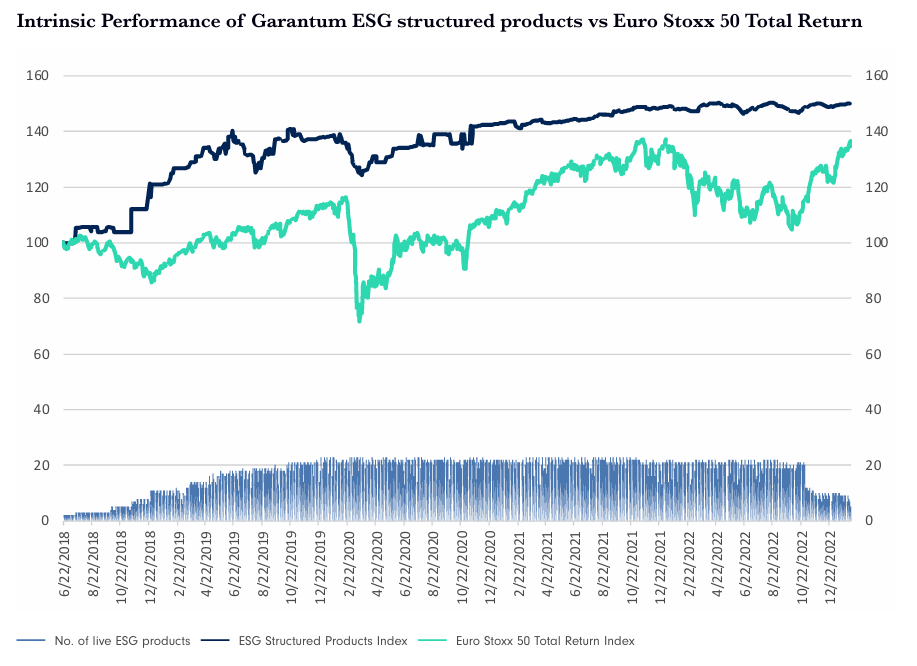
To be able to compare the performance of the selected products, we created an index of Environmental, Social, and Governance (ESG) structured products started on 22nd June 2018, with a starting value of 100. The main objective of the index was to provide investors with a benchmark to measure the performance of ESG structured products and make informed investment decisions. The index aimed to bring transparency to the ESG investment market, making it easier for investors to compare the performance of ESG products with other conventional investments.
Over the past few years, the index has grown significantly, reaching its highest level with 22 live products. This growth can be attributed to the increasing demand for sustainable investments and the growing recognition of the importance of ESG factors in the investment process. The usage of structured products also allowed to lower the volatility of its intrinsic performance (instead of using the indicative prices from issuers compared with equity markets. Specially during the COVID bear market in February/March 2020.
As of January 6th, the index of ESG structured products is currently valued at 150, while the Euro Stoxx 50 total return, which started at the same value of 100, is now at 133. This indicates that the ESG structured products have outperformed the conventional Euro Stoxx 50 index including dividends. The outperformance of the ESG structured products is a testament to the increasing popularity and significance of sustainable investing. The growth of the ESG index serves as a reminder of the importance of considering ESG factors in the investment process and highlights the potential for strong returns from sustainable investments.
Product examples
The product chosen for this case study is BNP AO Grön Hållbar SFB 90 3779 (ISIN: SE0013234267).
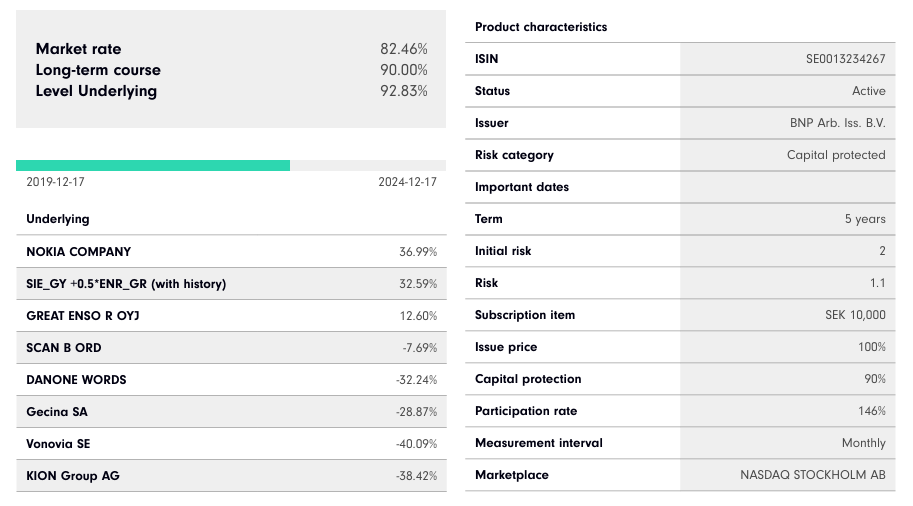
The investment is based on a green bond issued by the producer, BNP Paribas and arranged by Garantum. It means that the amount invested is earmarked for lending to climate and community-positive projects. The investment has two main risks: Credit risk – that the issuer is unable to fulfill its obligations; and market risk – in the event of a failure the rise will not give any return. This is a triple impact investment product, with the impacts being:
1. The possibility of a return is linked to eight Companies that contribute to the fulfillment of one or more of the UN’s 17 global objectives for sustainable development.
2. Garantum donates part of its income, at least 1% of the nominal amount, in the investment to the foundation ‘For Baltic Salmon’. The purpose of the Foundation is to promote the long-term sustainable management of wild salmon and trout stocks in the Baltic Sea and its rivers.
3. The funding is based on a green Bond issued by the producer, BNP Paribas, which complies with the principles of green bonds.
The product offers a 90% capital protection but at the same time, there is a potential for lower funding which would increase the risk of lesser returns compared to other products. Structured products are usually less liquid compared to other asset classes.
ESG Score of the product
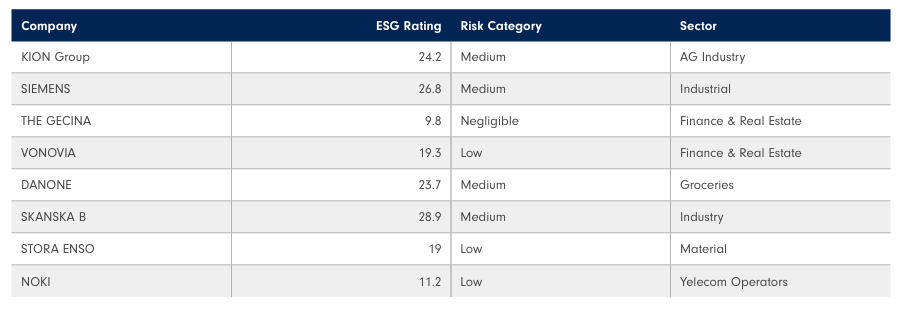
The ESG score of the underlying companies are evaluated by Sustainalytics. Sustainalytics is an independent global player in ESG evaluation. They measure a company’s exposure to industry-specific material ESG risks and how well a company is managing those risks. The ESG scale defined by sustainalytics is:

The Sustainalytics ESG score for the underlying companies of BNP AO Grön Hållbar SFB 90 3779 is as given below:
Research over the last decade has consistently shown a correlation between a company’s ESG performance and its financial performance. For example, a meta-study that analyzed over 2,000 studies found that 90% of them showed a positive or neutral correlation between ESG and financial performance. Additionally, an analysis by the Center for Sustainable Business at NYU Stern and Rockefeller Asset Management found that 58% of cases showed positive financial performance as a result of strong ESG performance, with 13% showing neutral performance, 21% showing mixed results, and 8% showing negative results. Furthermore, the study found that efforts to decarbonize a business strongly correlated with financial performance.
Performance of the ESG product VS a non-ESG product
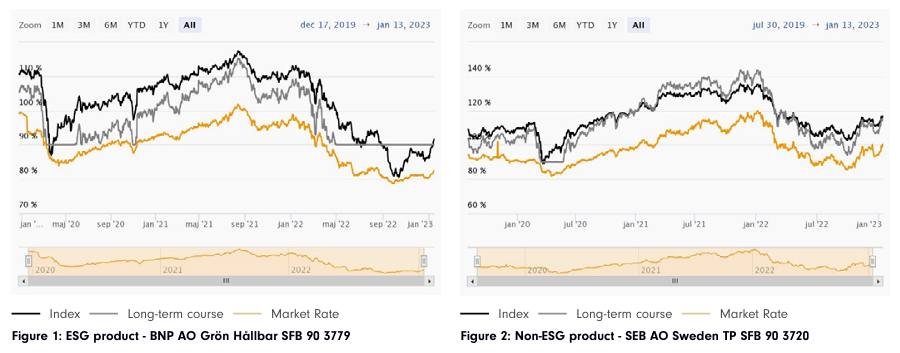
As seen from the performance charts, currently the ESG product is underperforming with a 10% loss, which is capped because of the 90% capital protection offered by the product. To further analyze some of the key performance indicators of the two products along with the Euro Stoxx Index as a reference, below are some the metrics that are taken into consideration:

Benefits & Drawbacks of ESG Investing
Some of the benefits of ESG investing are:
1. Improved risk management: ESG factors can provide insight into potential risks that may not be reflected in traditional financial analysis, such as reputational risks and regulatory risks.
2. Long-term financial performance: Companies that prioritize ESG factors may have better long-term financial performance due to improved operational efficiency and stronger relationships with customers and stakeholders.
3. Positive impact: Investing in ESG products can promote positive social and environmental outcomes and contribute to sustainable development.
4. Invest in companies that align with one’s values: ESG products may appeal to investors who want to align their investments with their values, even if it comes with potential lower returns.
Whereas the drawbacks can be:
1. Limited investment options: The universe of ESG products is still relatively small and may not offer the same level of diversification as traditional investments.
2. Lack of standardization: There is currently no universally accepted standard for what constitutes an ESG investment, which can make it difficult to compare different products and assess their environmental and social impact.
3. Higher costs: ESG products may have higher fees than traditional investments due to the additional research and analysis required to assess the environmental and social impact of investments.
4. Limited historical data: There is a lack of historical data on the performance of ESG products, which can make it difficult to assess the long-term financial performance of these investments.
Feedback from investors on sustainable investing
• Retail market for ESG is still in early stages
• Demand for such products have only started recently
• Demand for ESG investments has until recently almost solely been driven by institutional investors.
Conclusion
In conclusion, this case study of Garantum’s ESG-linked structured product illustrates the possible advantages of introducing ESG variables into the investment process. In order to better align their investments with their beliefs and maybe increase financial performance, investors may want to think about including ESG-linked products into their portfolios. The product studied has performed well and attracted a sizable number of investors.
However, it is important to note that the potential returns of any investment will depend on a variety of factors such as market conditions, the specific assets included in the product, and the specific investment strategy being followed. Some research has suggested that ESG-focused investments may have slightly lower returns compared to non-ESG investments, while other studies have found no significant difference in returns between the two. Nevertheless, the primary goal of ESG products, which is to generate positive social and environmental impacts while also providing some level of financial return to investors, can be achieved.
Garantum believes that, in the long run, companies that do not focus on green investment and take responsibility for ESG issues will have a harder time attracting capital. This subsequently will affect capital costs, profitability and their stock performance. In light of this, EET can facilitate the process of redirecting investments towards more sustainable options by making data more consistent and readily available. This enables a more informed decision-making process that is based on best practices. Overall, this case study suggests that ESG-linked products may be more appealing to investors who are looking to align their investments with their values and make a positive impact on the world, even if it comes at the potential cost of somewhat lower financial returns.