The largest non-US issuer of US structured products outgrew its peers by leaning into income and widening its client base.
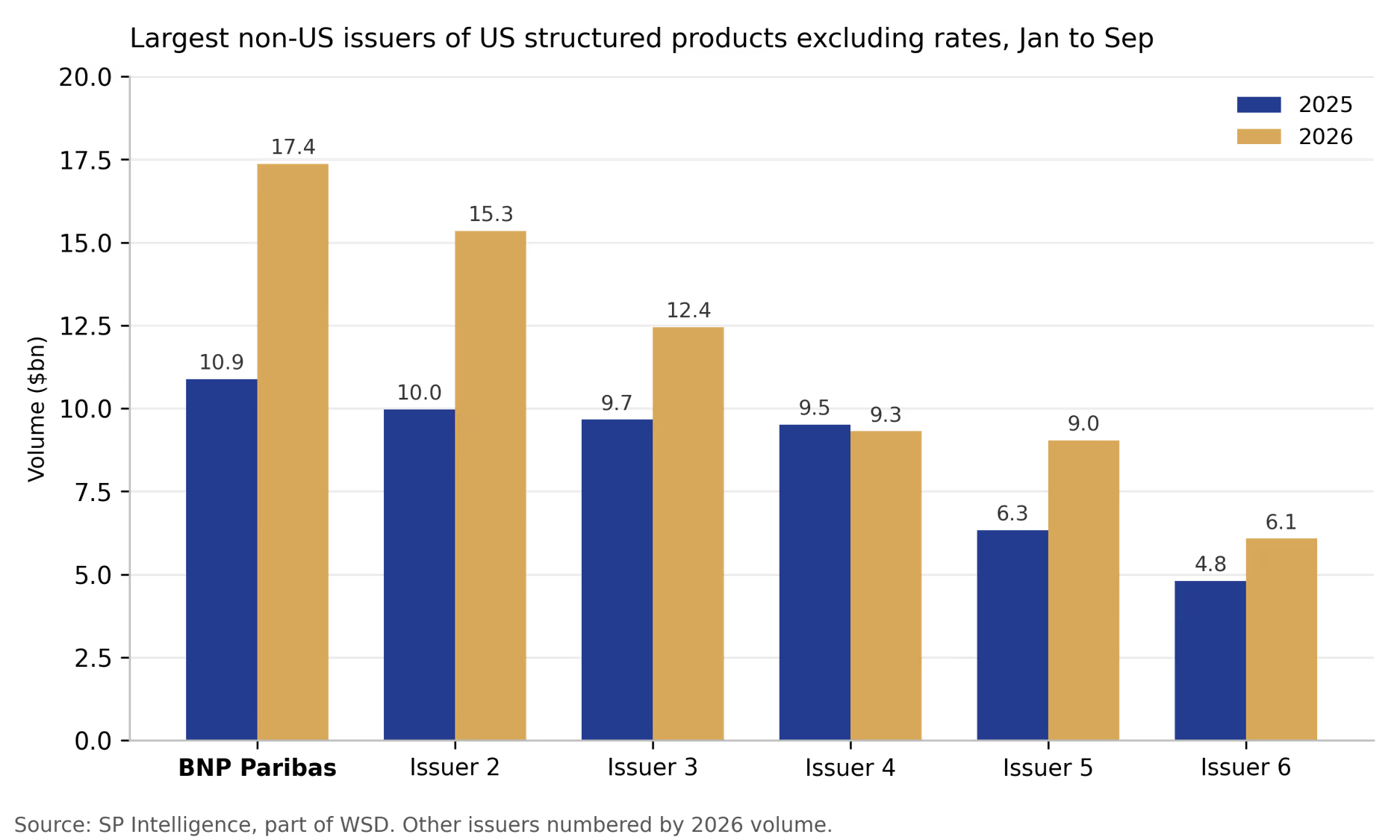
Through September, BNP Paribas issued $17.37 billion of US structured products, up 59.5%. BNP Paribas is not active in rates-linked notes, and excluding them, it was the fourth-largest issuer in the market with a 9.0% share, the largest non-US issuer and the fastest-growing of the non-US issuers placing more than $5 billion. The market excluding rates grew 44.4%. That performance has earned BNP Paribas Best Non-US Issuer at the SP Intelligence USA 2026 Awards for Excellence.
Trust, then volume
Excluding rates, BNP Paribas’s share rose to 9.0% from 8.1%. Momentum held into the third quarter, when its volume rose 47.8%, against 37.8% for the market excluding rates.
Nicolas Georges, Managing Director and Head of Cross Asset PB&D Sales, Americas excluding Brazil, credits a year of restructuring and hiring that brought “increased client trust and deepened engagement”, with volume growing among both existing and new clients. Two index suites, Defined Volatility and Multi Asset Diversified, have set the product mix apart, he says, consistently ranking on the podium for performance and pricing.

What changed
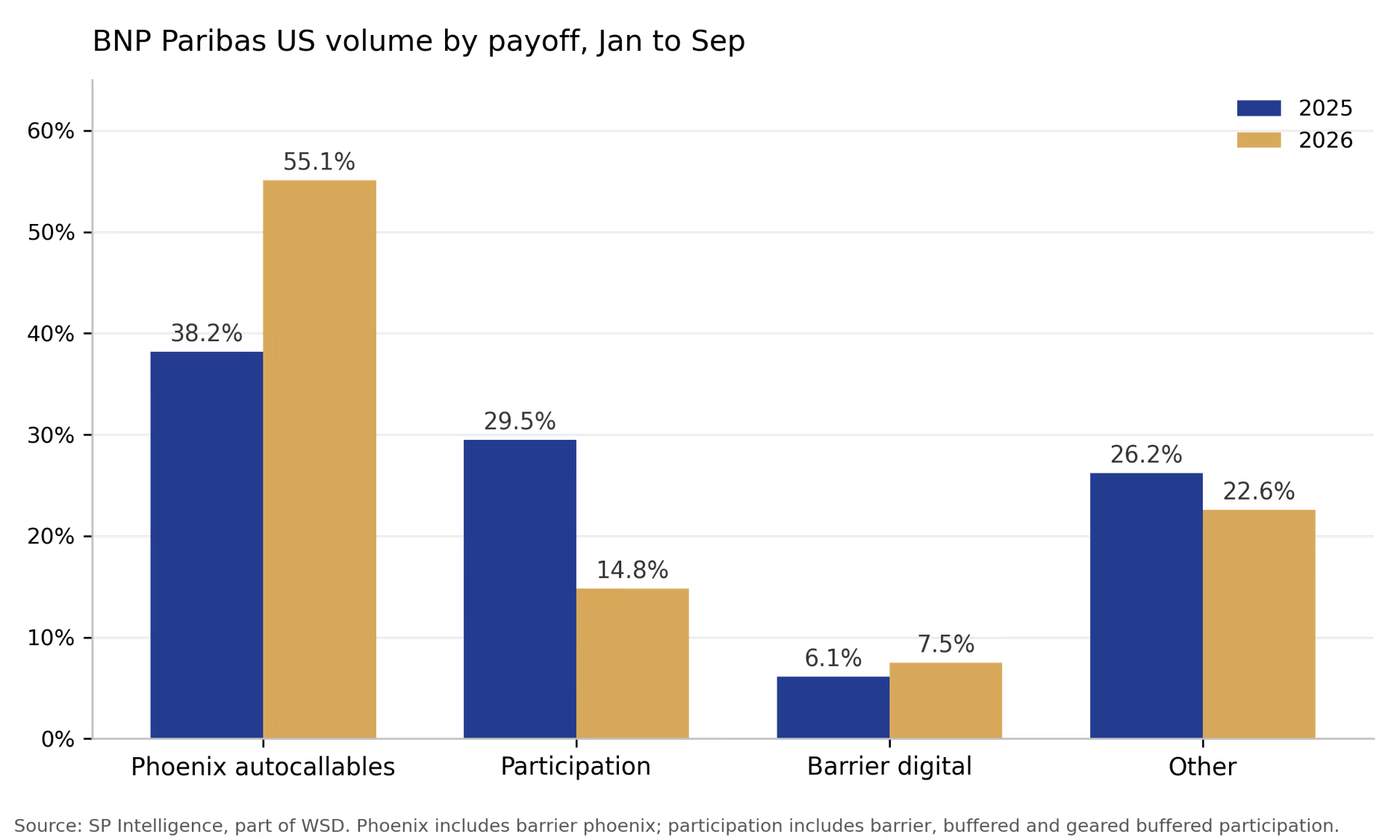
The growth came from income. Phoenix autocallables rose to 55.1% of BNP Paribas’s volume from 38.2% and drove more than four-fifths of its growth, while participation notes fell to 14.8% from 29.5%.
The client base widened at the same time. Two wirehouses that did not distribute BNP Paribas notes a year ago placed $2.72 billion between them. Its note count rose 37.5% to 7,930, and its average note size rose 16.0% to $2.2 million.
Pricing at scale
Behind that is a pricing engine that BNP Paribas says handles hundreds of thousands of quotes a day, with trade volumes on par with Tier 1 US banks, giving broker-dealers and platforms the speed and reliability to execute. The cross-asset structures gaining ground in Europe have not followed: they “have not yet reached standardisation in the US”, Georges says, and were not a significant driver of growth this year.
The next phase
BNP Paribas expects its share to keep rising in 2027, from deeper relationships with existing clients and a wider client footprint. It also expects to convert more buyers to its QIS-based strategies, which it says have performed strongly. Autocallables will remain the main driver, Georges says, but a market downturn could shift demand towards principal-protected notes.
Technology underpins both. AI is now “integral to our daily operations”, he says, driving efficiency in client requests, pricing and product engineering, and BNP Paribas plans to keep investing to modernise its whole platform.
The scale is in place. The next year is about turning it into a wider, deeper client base.
Source: SP Intelligence, part of WSD. Data covers US structured products across all wrappers, 1 January to 30 September 2026, compared with the same period of 2025. Rankings and market shares exclude rates-linked notes.