
BBVA runs a growing onshore business in the US alongside the market’s largest Reg S book, built on single-stock coupons, longer tenors and a small but growing credit line.
Through September, BBVA issued $6.57 billion of structured products through its US platform, up 41.1% year on year. The business runs on two tracks. About 63% is onshore, sold to US investors, and grew 43.3%. The rest, $2.44 billion, is issued under Reg S to non-US investors, including in Latin America, and grew 37.7%. That makes BBVA the largest Reg S issuer in the market, well ahead of the next issuer. Its Reg S business has earned BBVA Best Reg S Issuer at the SP Intelligence USA 2026 Awards for Excellence.
The more interesting story is what the book looks like, and both tracks are converging on income. In the Reg S book, income products make up 86.9% of volume, led by phoenix notes, including barrier phoenix structures, and dual-currency notes, which alone account for $398 million. Onshore, the income share rose to 77.4% from 57.3% a year earlier as capital-protected notes shrank, against 43.7% for the US market. BBVA issued in at least eight currencies this year, from Mexican and Colombian pesos to yen.
Going longer, going credit
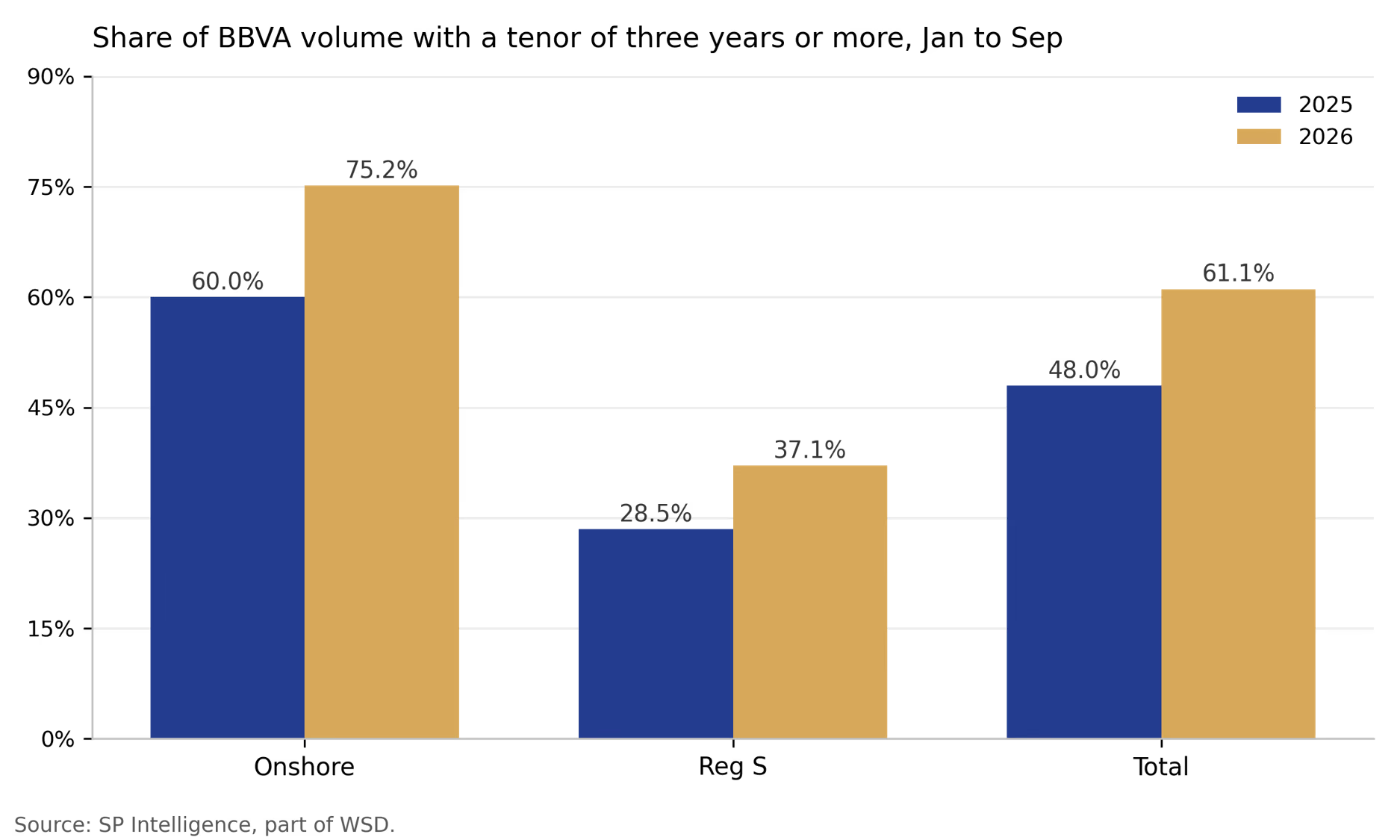
BBVA’s book is getting longer. Notes of three years or more now make up 61.1% of volume, up from 48.0% a year earlier. Three-to-four-year notes drove the shift, rising to 35.6% from 19.6%. The lengthening is concentrated onshore, where 75.2% of volume is three years or longer, up from 60.0%. Reg S clients still buy shorter, though that share rose to 37.1% from 28.5%.
Credit is still a small part of the book. CLNs have become “increasingly attractive when credit spreads widen”, says Valentin Gratteau, Executive Director, Investment Solutions Sales U.S. & Latam at BBVA CIB. BBVA sees credit as its main growth area for 2027, citing strong appetite for fixed income and Latin American investors’ “sophisticated understanding of credit products”, and is extending digital pricing to more credit-linked payoffs.

Coupons from single names
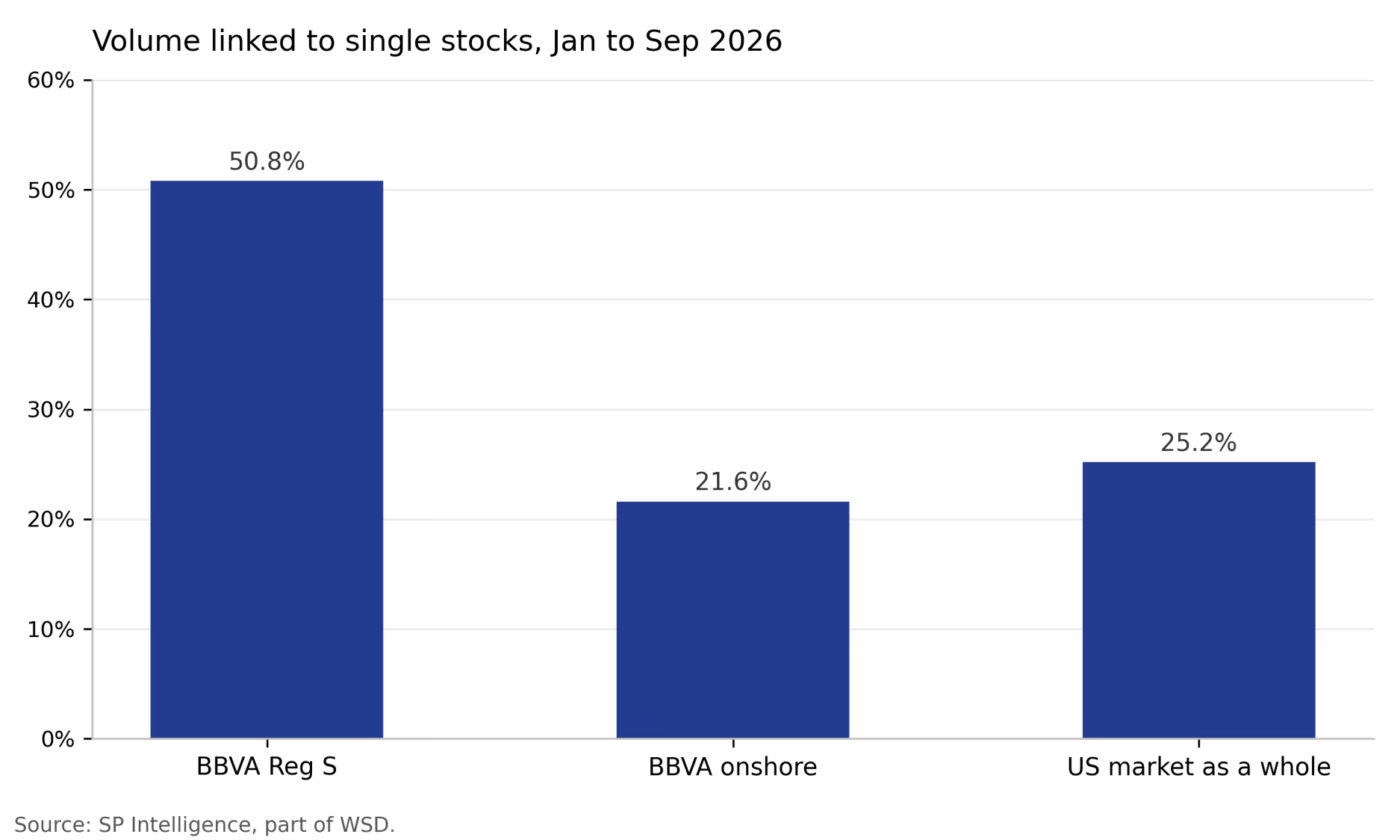
On the equity side, the two tracks diverge. In the Reg S book, single stocks underlie 50.8% of volume and 45.9% of worst-of volume, the direct route to a higher coupon. Onshore, the book is index-led, with single stocks at 21.6% of volume. Across both, single stocks make up 32.5% of BBVA’s volume, against 25.2% for the US market as a whole.
That demand rewards speed on new names. SpaceX began trading on Nasdaq on 12 June. BBVA priced its first SpaceX-linked note 17 days later, on 29 June, the second issuer to do so, and has kept issuing since. According to BBVA, its SpaceX-linked notes reached almost $50 million by the end of September.
Pricing as infrastructure
That speed rests on technology. BBVA prices through its single-issuer platform, BBVA ePricer, and is widening the payoffs and underlyings it can firm-price digitally.
The platform also feeds back. It lets BBVA “capture a broader range of market feedback and continuously assess our pricing competitiveness”, Gratteau says. The breadth shows in the data: BBVA’s book now spans 1,108 equity underlyings, up from 852 a year earlier.
Set against the wider US market, BBVA’s book stands out: more single stocks, longer tenors and a growing credit line. Those are its clients’ choices. What BBVA brings is the pricing capacity to serve them across more than 1,100 underlyings.
Source: SP Intelligence, part of WSD. Data covers 1 January to 30 September 2026, compared with the same period of 2025. BBVA figures cover notes traded through its US platform: onshore notes sold to US investors, and Reg S notes sold to non-US investors through US international desks and offshore.