The fastest-growing major issuer in the US built its book on index income, a global hedging engine and knowing where to compete.
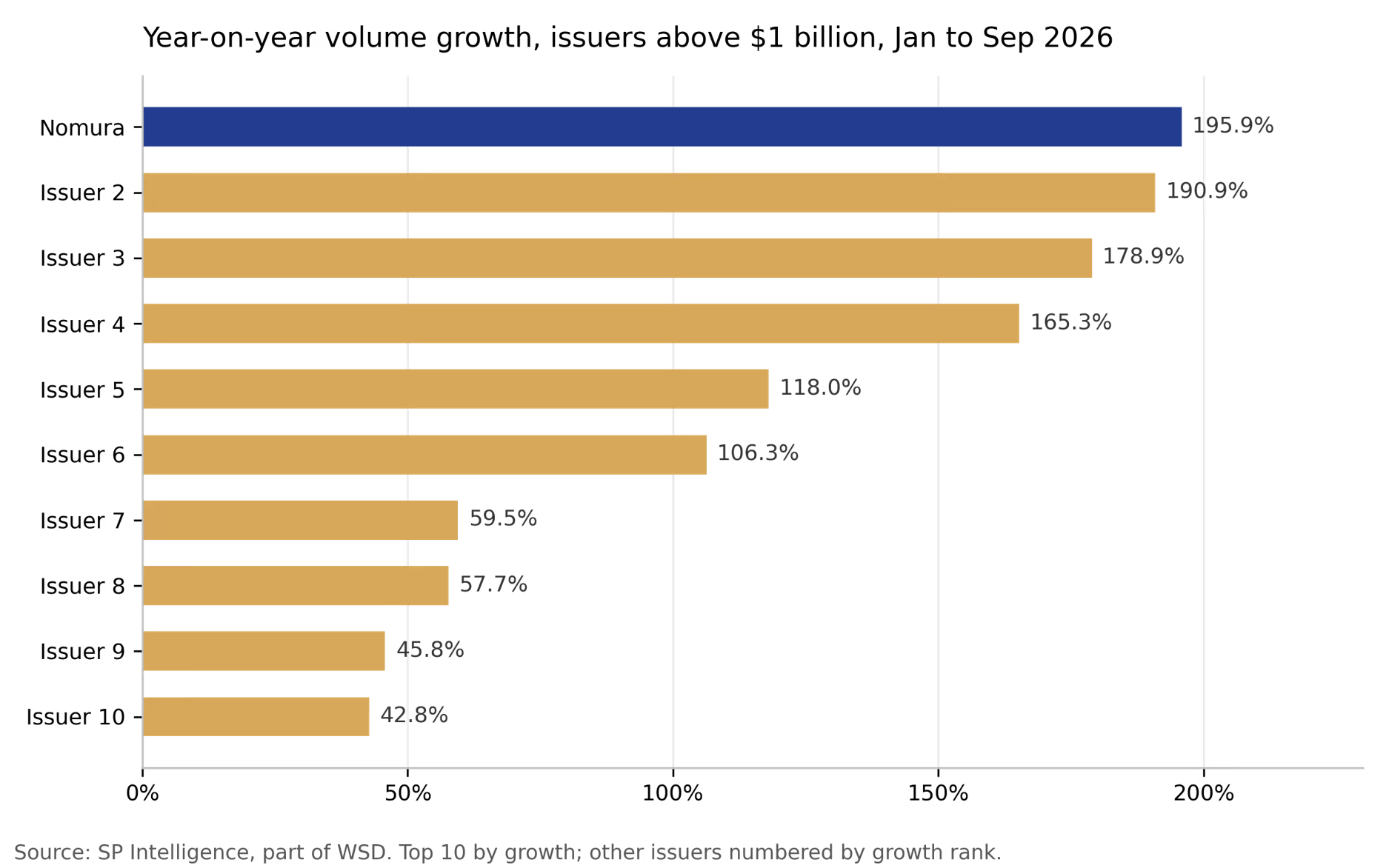
Through September, Nomura issued $1.42 billion of US structured products, almost three times its volume a year earlier. That is growth of 195.9% in a market that grew 36.5%, and no other issuer placing more than $1 billion grew faster. That performance has earned Nomura Issuer Rising Star at the SP Intelligence USA 2026 Awards for Excellence.
A deliberate build
The growth was planned and a top-of-the-house priority. “This was very deliberate,” says Jason Jerutis, Head of Structured Note Distribution, Americas at Nomura. The firm committed in 2023 to build out its US structured products business, hiring across sales, structuring and trading.

It did not start from zero. Nomura’s long presence in Asian structured notes meant much of the infrastructure was already in place, and capital, lifecycle technology and API connections followed. Jason Varano and Alex Witten, Co-Heads of US Equities at Nomura, frame it as a global rollout rather than a US project, backed by Nomura’s “global platform and balance sheet”. They add that its success is the result of a firm-wide commitment to become a top-tier player in the US. The reach already extends beyond US investors: RegS notes for offshore clients made up almost a third of Nomura’s volume this year.
Winning the shelf
Nomura’s distribution has broadened well beyond where it started. Its growth has come from a targeted approach across multiple channels: private banks, independents and RIAs.
Varano and Witten credit much of the success to what they call a best-in-class trading desk, with strong execution and deep product breadth from day one. Being a Japanese issuer has helped too, giving distributors issuer diversification.
Emphasis on its strengths
The book is built on index income. Nomura has had success with both autocalls and issuer calls, which make up the majority of its volume, and the mix has shifted as the shelf widened. Autocallables now account for almost half, up from just over a quarter, while issuer-callable notes have fallen to just under a third of the volume.
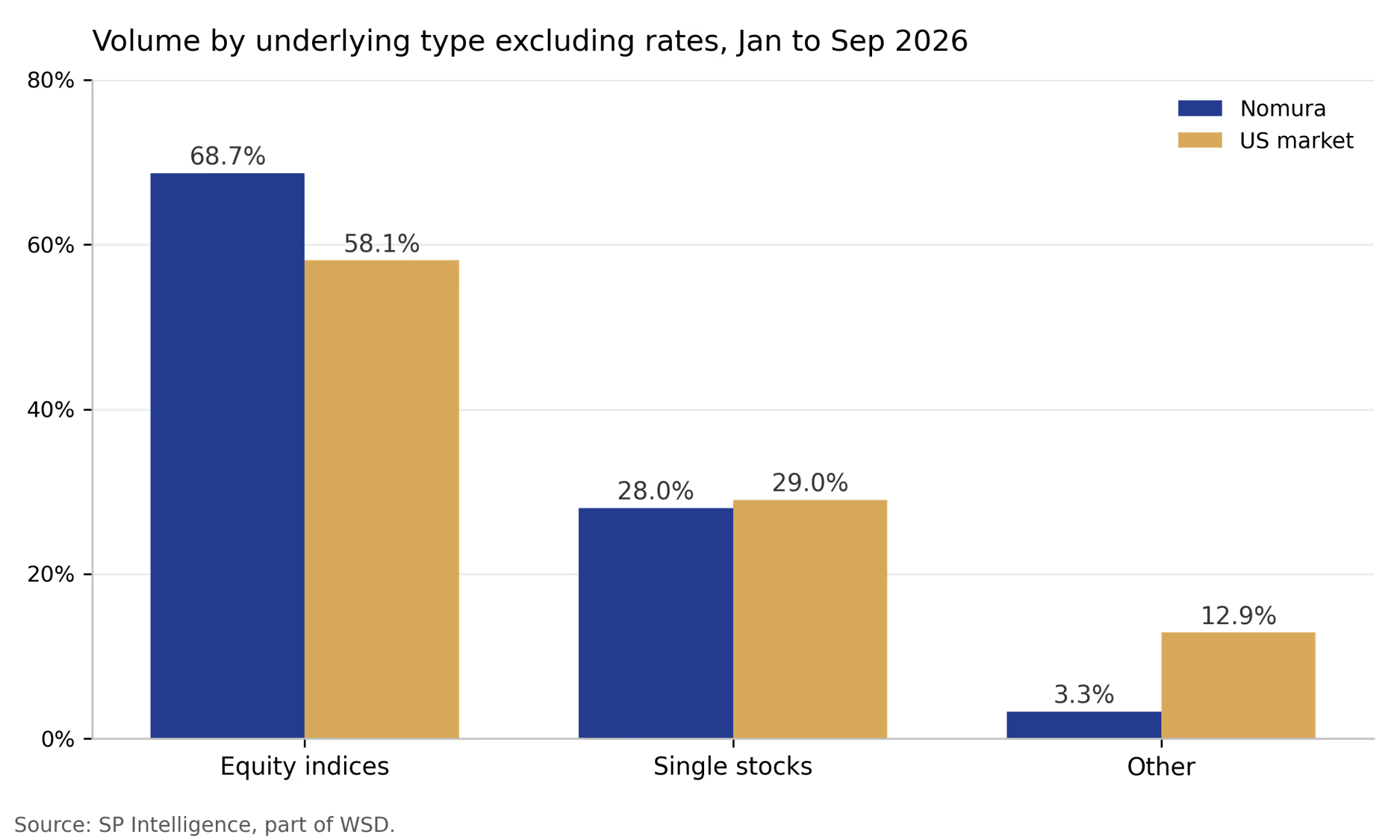
What stands out is how Nomura talks about its strengths. It is “very candid with our distribution partners on what our strengths are, and where it can provide the best value for clients”, Jerutis says. He credits those conversations with building trust in the market.
The next phase
Nomura’s next step is to widen what it sells, not just how much. Jerutis points to quantitative investment strategies (QIS), where Nomura already has a “premier sales and structuring team in place that is positioned to gain market share”, broader cross-asset capability and structured derivatives “regardless of the wrapper”. Market demand points the same way: QIS-linked volume in the US more than doubled this year to $8.53 billion.
The first phase made Nomura a strong competitor, adding almost $1 billion of volume this year. The next phase has to prove that a core issuer can keep growing like a new one.
Source: SP Intelligence, part of WSD. Data covers 1 January to 30 September 2026, compared with the same period of 2025.