A fast-growing distributor credits its plumbing, not the market.

Through September, Citi Wealth placed $5.29 billion of US structured products, a 2.4% share of a market that grew 36.5%, and its volume has grown strongly every year since it unified its platform in 2023, according to Citi. That performance has earned Citi Wealth Distributor Rising Star at the SP Intelligence USA 2026 Awards for Excellence.
Growth from the plumbing
The growth is staying on the book. According to Citi, assets held in its structured notes stand at $5.70 billion, more than its $5.29 billion of placements this year, so the volume is not just passing through.
The groundwork predates the numbers. Citi Private Bank and Citi’s retail wealth business merged into Citi Wealth in 2022, each with its own structured note platform. In 2023 Citi unified distribution, pairing the Private Bank’s customised, best-execution model with the retail platform’s reach. Lifecycle management, advisor education and portfolio monitoring moved onto iCapital.
Vishal Desai, Managing Director and Head of Americas Structured Notes at Citi Global Wealth Investments, who joined Citi in 2020 after more than 14 years at HSBC, is clear about the order of causes. Supportive markets and strong product performance helped, but “the primary driver has been the deliberate transformation of our platform, operating model, and advisor engagement strategy”.

Breadth without favourites
The shelf has widened with the volume. Citi Wealth brought 1,284 notes to market through September, across 90 single stocks as well as a range of indices and ETFs. Citi Wealth now uses 13 issuers, up from 10 a year earlier, Desai says.
Notes are typically auctioned across several issuers, Desai says, with allocation going to the best economics for the client. SPi data bears out the result. Citi’s own paper, the largest issuer, accounted for 21.0% of Citi Wealth’s volume this year, closely followed by the next issuer at 18.7%, and seven issuers each held more than 5%.
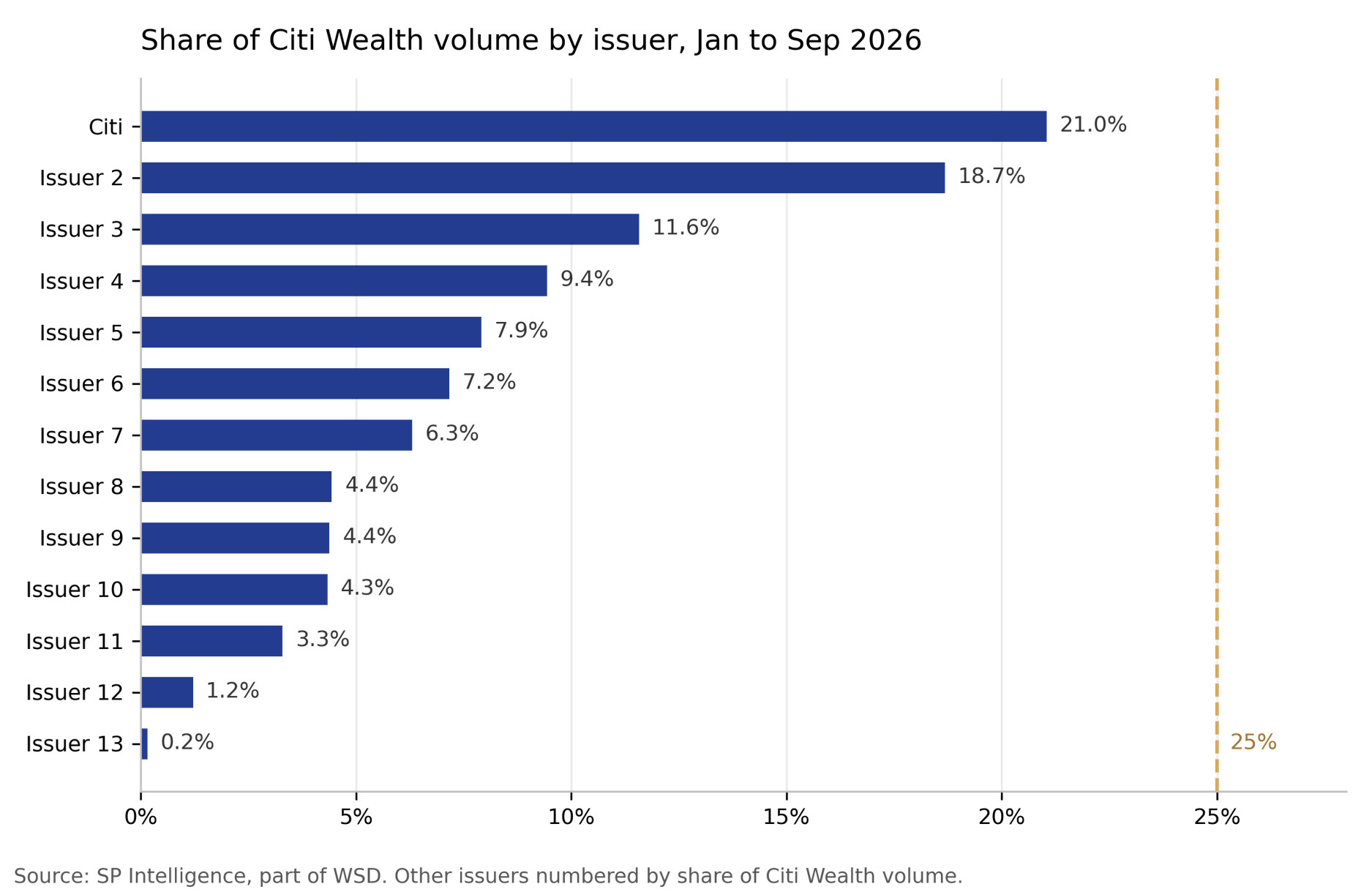
“Issuer leadership shifts from year to year,” Desai says, and no single issuer typically exceeds 25% of volume.
Two books, one shelf
Citi Wealth runs two distinct client books, and its product mix reflects both. According to Desai, retail demand leans on phoenix autocallables linked to large-cap single stocks, much of it in the Magnificent Seven. Single stocks underlie 56.3% of Citi Wealth’s volume, against 25.2% for the market, and the Magnificent Seven account for 61.3% of that single-stock volume.
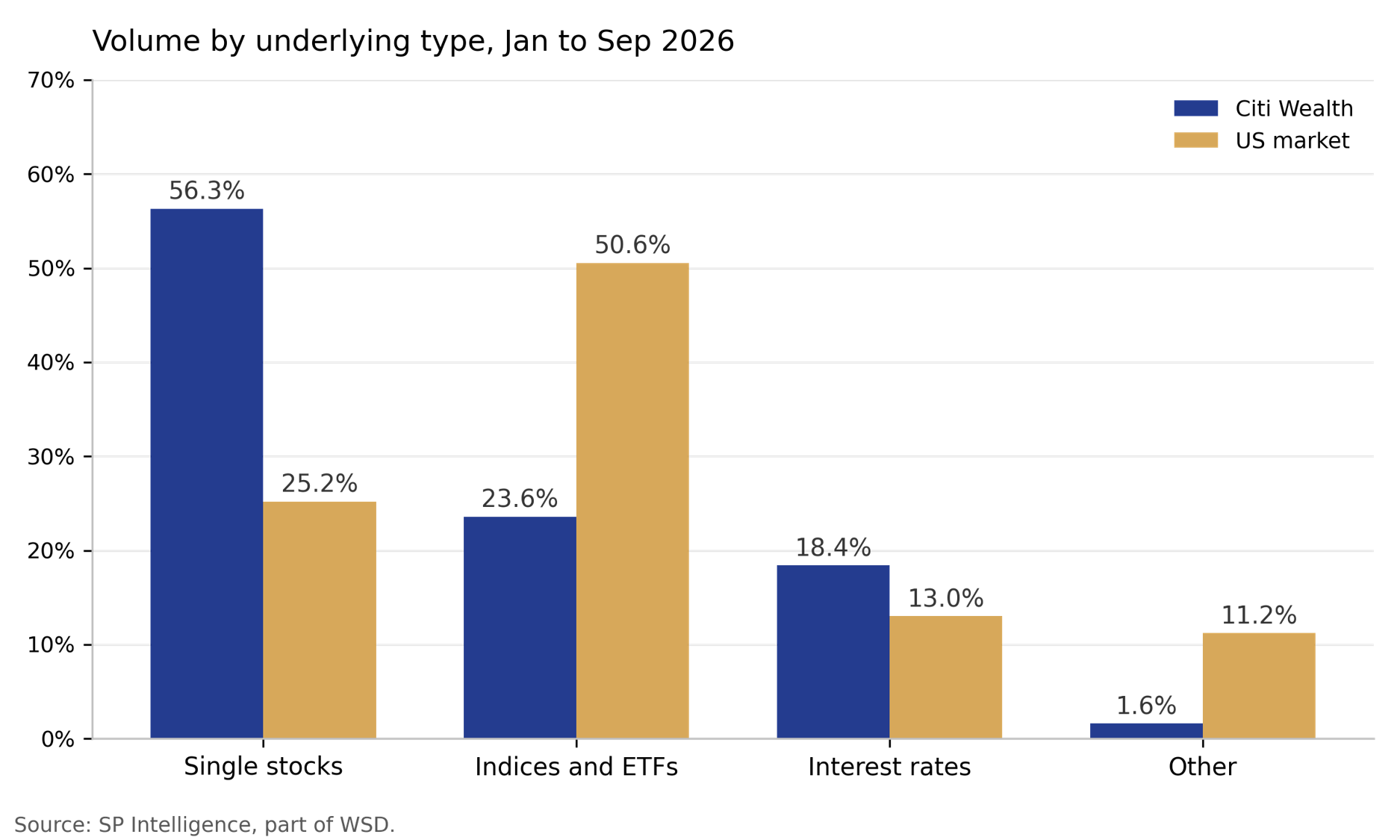
The Private Bank pulls the other way. Desai says family offices have bought principal-protected notes on broad indices, helped by higher rates. Capital-protected notes, including fixed-rate notes, account for 23.5% of Citi Wealth’s volume, against 17.9% for the market, and 96.5% of its principal-protected growth note volume is linked to indices.
Maturing notes have paid out. Citi Wealth notes worth $1.36 billion matured or were called through September, with a simple average realised performance of 15.7% over their lives.
The next phase
Growth gets harder from a larger base, and Citi Wealth’s 2027 plan is to broaden rather than repeat. It wants demand to move beyond single-stock income towards buffer notes, index-linked autocallables, and themes such as cybersecurity, infrastructure and the physical buildout behind AI.
The bigger ambition is positioning. Desai sees “considerable runway to position structured products as a strategic portfolio allocation rather than solely a tactical investment”. On the platform side, investment goes into workflow integration, lifecycle management and automated pricing and auctions.
The first leg of the growth came from fixing the platform. The next has to come from changing how clients use it.
Source: SP Intelligence, part of WSD. Data covers US structured products across all wrappers, 1 January to 30 September 2026, compared with the same period of 2025. Assets held are as reported by Citi.