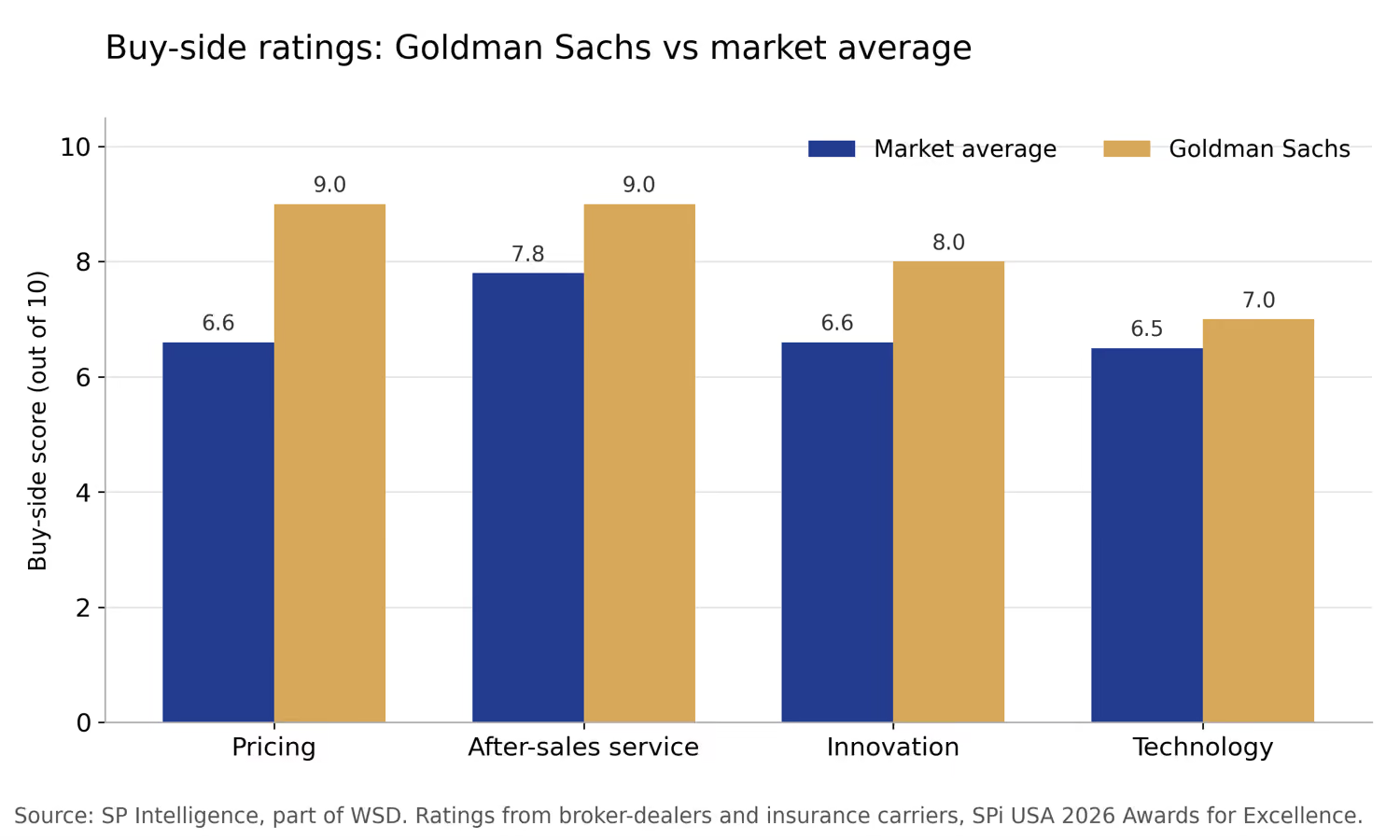
The buy side scored Goldman Sachs 9.0 out of 10 on pricing, against a market average of 6.6. It also led on after-sales service, innovation and technology.
Goldman Sachs has won three of the most competitive awards at the SP Intelligence USA 2026 Awards for Excellence: Best Derivatives House, Best Hedge Provider (Annuities) and Best Issuer.
What the buy side said
Broker-dealers and insurance carriers rated the Best Derivatives House finalists out of 10 on four measures: pricing, after-sales service, innovation and technology. Goldman Sachs scored above the market average on all four. The widest gap was on pricing.
Where the market falls short
The market averages are as revealing as Goldman Sachs’ own scores. After-sales service is where issuers score highest overall, at 7.8, which makes good service close to table stakes. Pricing, innovation and technology all sit around 6.5. These are the areas where distributors are least satisfied across the market, and where an issuer can still separate itself from the pack. Goldman Sachs’ widest lead came in exactly that group, on pricing.
Funding drives pricing
Behind the pricing score is funding. Judging by the headline rates and participation rates in its products this year, Goldman Sachs offered higher funding levels than its peers, and funding is the single biggest factor in delivering the best pricing. It sets the budget for every note: a higher funding level leaves more room for coupons, participation rates and downside protection, so the advantage flows straight to the end investor.
For distributors, that makes funding the first thing to compare when choosing between issuers. It says more about the terms an issuer can offer than any other single measure.
The bank adds sustained investment in pricing and risk technology, including OTC hedging, which lets it price consistently across wrappers, structures and client segments.
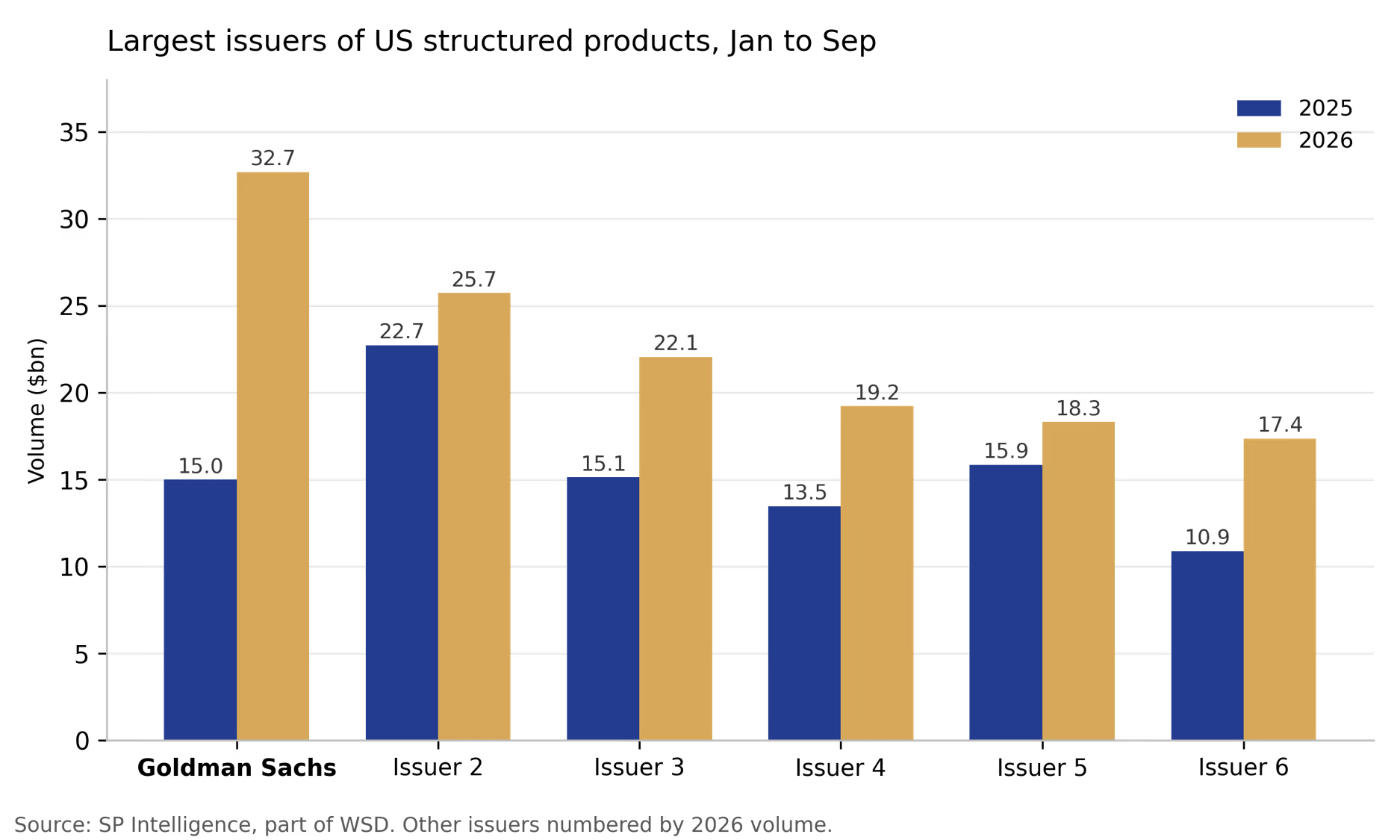
The volumes are consistent with the buy side’s verdict. Through September, Goldman Sachs issued $32.71 billion of US structured products, up 118.0% in a market that grew 36.5%. That made it the largest issuer, with a 14.7% share, $7 billion ahead of the next. Its third-quarter volume rose 94.6%, against 32.8% for the market.
Support for the life of the note
After-sales service matched pricing as Goldman Sachs’ highest score, at 9.0 against a market average of 7.8. It is also the measure on which the market as a whole scores highest, which makes standing out harder.
Boris Romanovsky, Vice President, Structured Product Sales at Goldman Sachs, says partners value consistency and dependable support most “when markets are volatile and clients require consistent execution”. Every product the bank adds needs the pricing, risk and operational support to carry it through its life, and investment in lifecycle technology has made that support scalable.
Innovation built on demand
Innovation scored 8.0 against 6.6. The evidence is in the demand Goldman Sachs is meeting: custom baskets, thematic investments and single-stock solutions, alongside standardised products. The bank’s approach, he says, is “not simply to add products for the sake of expanding the shelf, but to anticipate client demand across various market conditions”.
Technology has widened access to that innovation, bringing capabilities once reserved for larger transactions to advisors at every scale. Goldman Sachs also led on technology itself, at 7.0 against 6.5. It was the narrowest gap of the four, which suggests the buy side sees technology as what enables the bank’s pricing, service and innovation rather than as a differentiator on its own.
Hedging indexed annuities
Insurance carriers named Goldman Sachs Best Hedge Provider (Annuities). The pricing and risk management capabilities behind its notes business, including OTC hedging, also support the hedging of indexed annuities. For carriers, the cost of the hedge feeds directly into the crediting rates they can offer, so pricing matters as much here as in notes.
The business is central to the bank’s plans. It expects continued convergence of notes, ETFs and indexed annuities through custom indices, which puts its hedging capability alongside its issuance franchise rather than behind it.
Breadth and outcomes
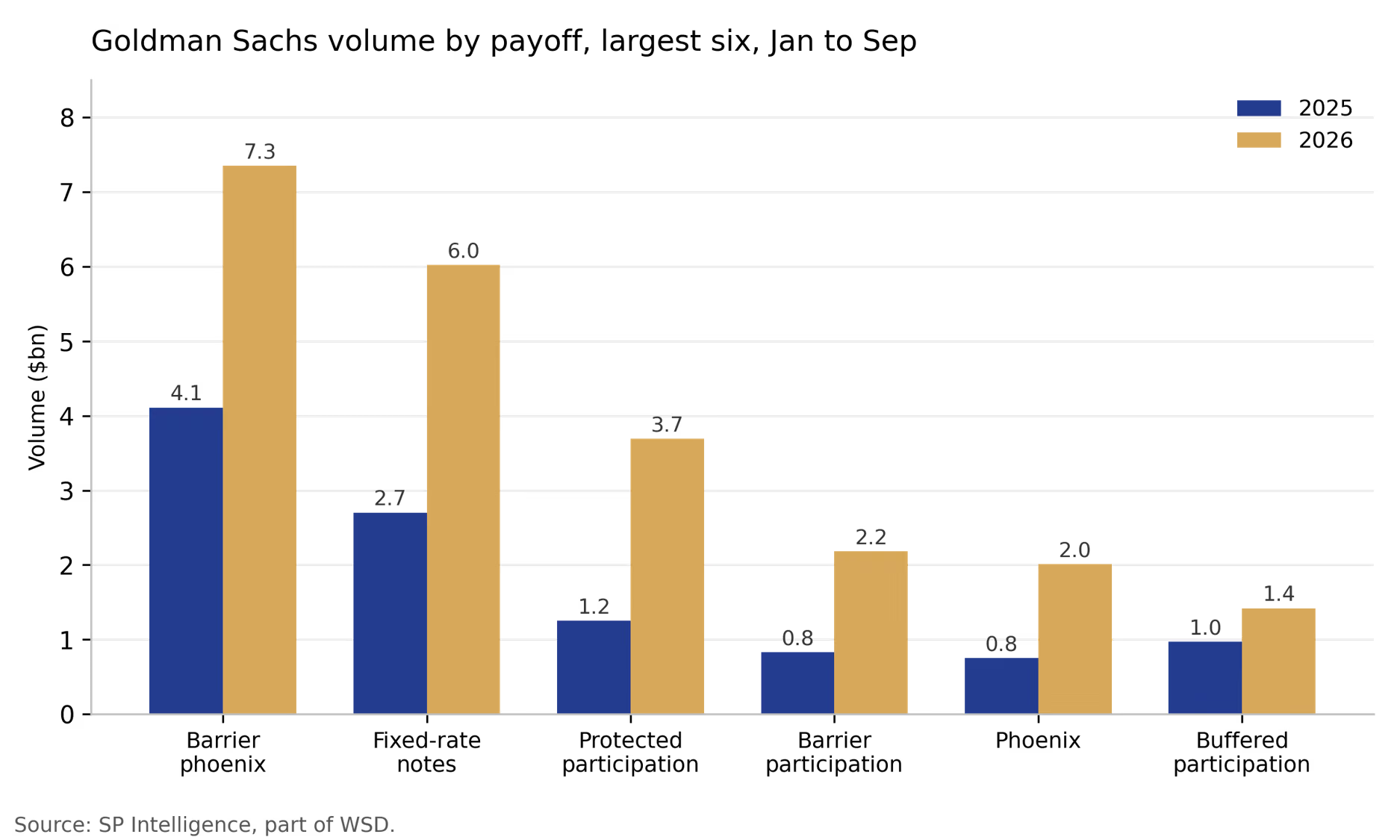
The Best Issuer criteria reward breadth and outcomes. Through September, Goldman Sachs issued notes on 1,033 unique underlyings, up 79% from 576 a year earlier, across 44 payoff types. Barrier phoenix notes rose to $7.35 billion from $4.11 billion, and protected participation notes almost tripled to $3.69 billion.
Notes issued by Goldman Sachs that expired through September returned an estimated 11.6% on average. The bank designs from the investor’s objective backwards, whether income, participation or a defined outcome, and tests how a note may behave across market environments, not only at issuance.
The next phase
Goldman Sachs sees growth in increasingly personalised outcomes. Its priorities as market leader are to keep investing in technology, widen access to differentiated solutions and strengthen partnerships across distributors, platforms, wholesalers and issuers.
Goldman Sachs leads on pricing, service and scale. The test for 2027 is turning that lead into ever more personalised outcomes for investors.
Source: SP Intelligence, part of WSD. Data covers US structured products across all wrappers, 1 January to 30 September 2026, compared with the same period of 2025.